Airtable landing page teardown: what to change
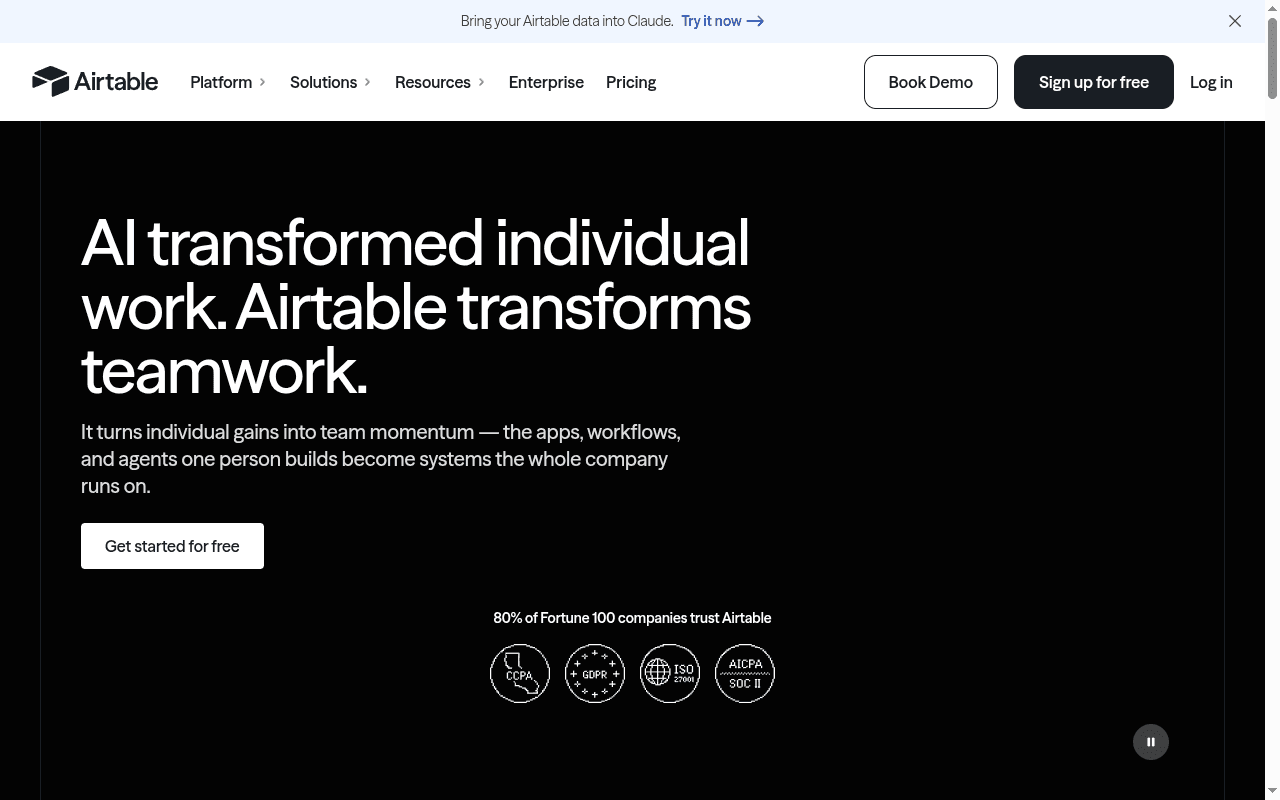
Airtable scores 68/100 on PageLint's quick copy audit — a mixed result — strong in places, leaky in others. Trust is the stronger lens at 69/100, while Clarity trails at 68/100. The biggest issue the engine flagged: “Jargon and insider terminology” (CL-5, high severity).
What to change
- 1 · CL-5 · highJargon and insider terminology
Multiple unexplained technical terms cluster in the hero and body without plain-language glosses: 'RBAC' (role-based access control), 'HyperDB', 'EKM', 'IDP synced groups', 'e-discovery', 'programmatic provisioning and de-provisioning', and 'fine-grained RBAC' all appear in a single infrastructure/security section with zero explanation. The page also targets a dual audience — the hero says 'No code required' and 'no technical expertise required,' explicitly courting non-technical users — yet the platform section reads like an AWS sales sheet. A non-technical ops manager or marketing lead cannot decode 'EKM,' 'IDP synced groups,' or 'HyperDB' without Googling. This is a textbook audience-tension jargon failure.
For each technical term in the infrastructure/security section, add a parenthetical plain-language gloss (e.g., 'RBAC (control who sees what)'). Alternatively, split the page into two audience paths or move the technical spec block to a dedicated enterprise/security sub-page linked from a single 'Enterprise-grade security' CTA. The hero and primary body must remain readable by the non-technical audience the page explicitly claims to serve.
CXL Institute, 'Landing Page Optimization' course (Peep Laja): clarity is the single highest-leverage conversion variable; jargon that excludes a stated target audience directly suppresses conversion by creating cognitive friction and trust loss.
- 2 · CL-6 · highSingle message focus
The page presents at least five distinct CTAs leading to different destinations and actions: 'Try it now' / 'Get started for free' (sign-up), 'Book demo' (sales), 'Interfaces — Create custom interfaces from your data' (feature page), 'Google Drive — Sync information and build workflows' (integration page), 'API Docs — Build with the Airtable API' (developer docs), 'Scripting — Build something custom with scripts' (developer feature), plus multiple 'Learn more' links and 'Explore AI Plays' CTAs. A first-time visitor faces a meta-decision: Am I here to sign up, book a demo, explore a feature, read docs, or browse templates? These CTAs serve fundamentally different user intents and funnel stages simultaneously.
Establish one primary CTA ('Get started for free') and one secondary CTA ('Book demo') in the hero, and demote all feature/integration/API links to a navigation menu or a lower-page 'Explore the platform' section. Every section's inline CTA should funnel back to one of these two actions, not branch visitors into separate product areas. Apply Fogg's principle: reduce the number of decisions to reduce abandonment.
Ogilvy, 'Confessions of an Advertising Man' (1963): 'A good advertisement is one which sells the product without drawing attention to itself' — fragmented CTAs draw attention to the interface rather than the conversion goal. CXL Institute research on attention ratio confirms that pages with a 1:1 attention ratio (one link per one goal) consistently outperform multi-CTA pages.
- 3 · TR-6 · highNo objection-handlers present near any CTA
The primary CTAs are 'Get started for free' and 'Book demo' in the hero, and 'Get started for free' in the closing section. Scanning the full body text and section headings, none of the standard objection-handling signals appear anywhere on the page: no 'no credit card required', no 'cancel anytime', no 'money-back guarantee', no '14-day free trial', no 'SOC 2' adjacent to a CTA (SOC 2 appears in a features list far from any CTA), no 'GDPR', no 'free plan', no 'no setup fee'. The security/compliance mentions (ISO, HIPAA, SOC 2) are buried in a feature grid section, not near any CTA.
Place at least 2 objection-handlers directly beneath or adjacent to each primary CTA. For example, add 'No credit card required · Cancel anytime' as microcopy under 'Get started for free', and consider adding a 'SOC 2 certified' trust badge near the CTA for enterprise visitors. This reduces purchase anxiety at the moment of decision.
CXL Institute anxiety lens research; Cialdini, R. (2001). Influence: The Psychology of Persuasion — reducing perceived risk at the point of commitment lowers friction and increases conversion.
All findings
7 findings shown · 9 of 16 checks passing
Jargon and insider terminology
Multiple unexplained technical terms cluster in the hero and body without plain-language glosses: 'RBAC' (role-based access control), 'HyperDB', 'EKM', 'IDP synced groups', 'e-discovery', 'programmatic provisioning and de-provisioning', and 'fine-grained RBAC' all appear in a single infrastructure/security section with zero explanation. The page also targets a dual audience — the hero says 'No code required' and 'no technical expertise required,' explicitly courting non-technical users — yet the platform section reads like an AWS sales sheet. A non-technical ops manager or marketing lead cannot decode 'EKM,' 'IDP synced groups,' or 'HyperDB' without Googling. This is a textbook audience-tension jargon failure.
For each technical term in the infrastructure/security section, add a parenthetical plain-language gloss (e.g., 'RBAC (control who sees what)'). Alternatively, split the page into two audience paths or move the technical spec block to a dedicated enterprise/security sub-page linked from a single 'Enterprise-grade security' CTA. The hero and primary body must remain readable by the non-technical audience the page explicitly claims to serve.
Single message focus
The page presents at least five distinct CTAs leading to different destinations and actions: 'Try it now' / 'Get started for free' (sign-up), 'Book demo' (sales), 'Interfaces — Create custom interfaces from your data' (feature page), 'Google Drive — Sync information and build workflows' (integration page), 'API Docs — Build with the Airtable API' (developer docs), 'Scripting — Build something custom with scripts' (developer feature), plus multiple 'Learn more' links and 'Explore AI Plays' CTAs. A first-time visitor faces a meta-decision: Am I here to sign up, book a demo, explore a feature, read docs, or browse templates? These CTAs serve fundamentally different user intents and funnel stages simultaneously.
Establish one primary CTA ('Get started for free') and one secondary CTA ('Book demo') in the hero, and demote all feature/integration/API links to a navigation menu or a lower-page 'Explore the platform' section. Every section's inline CTA should funnel back to one of these two actions, not branch visitors into separate product areas. Apply Fogg's principle: reduce the number of decisions to reduce abandonment.
No objection-handlers present near any CTA
The primary CTAs are 'Get started for free' and 'Book demo' in the hero, and 'Get started for free' in the closing section. Scanning the full body text and section headings, none of the standard objection-handling signals appear anywhere on the page: no 'no credit card required', no 'cancel anytime', no 'money-back guarantee', no '14-day free trial', no 'SOC 2' adjacent to a CTA (SOC 2 appears in a features list far from any CTA), no 'GDPR', no 'free plan', no 'no setup fee'. The security/compliance mentions (ISO, HIPAA, SOC 2) are buried in a feature grid section, not near any CTA.
Place at least 2 objection-handlers directly beneath or adjacent to each primary CTA. For example, add 'No credit card required · Cancel anytime' as microcopy under 'Get started for free', and consider adding a 'SOC 2 certified' trust badge near the CTA for enterprise visitors. This reduces purchase anxiety at the moment of decision.
Authority signals verifiable
Press/authority claim detected (Trusted by) but the logos/text are not linked to verifiable sources.
Wrap each press logo or 'Featured in' badge in an <a href> pointing to the actual article or brand page. Unlinked authority claims invite scepticism — the reader cannot verify them.
Hero 5-second test
"All your teams, all their workflows—connected in one workspace" — WHAT is unclear within 5 seconds. 'Workspace' could mean project management, spreadsheet, chat, CRM, or dozens of other tools. WHO is also vague ('all your teams' is everyone and therefore no one). The subhead 'Build AI-powered workflows that unify data, maximize collaboration, and set your teams up for long-term success' adds buzzwords but still doesn't clarify the product category or mechanism.
Rewrite the H1 to name the product category and a concrete differentiator, e.g., 'The no-code database that connects every team's work in one place.' Add a subhead that names a specific WHO: 'Used by ops, marketing, and product teams at 500,000 companies.' A visitor should be able to say 'it's a [category] for [audience]' in under 5 seconds.
Only one named individual; no team or founder faces evident
The only named individual in the content is Angela Yanes (Director of Product Operations) in a single testimonial quote. The social proof digest image alt texts are entirely generic ('Logo 1', 'Logo 2', '01 AI app building 1', 'media', etc.) with no headshot alt text patterns, no 'Meet the team' section, no founder attribution, and no other named individuals with photos or company affiliations visible.
Add a 'Meet the team' or founder section with named individuals, titles, and real photos. Expand the testimonial section to include headshots alongside names and company affiliations. At minimum, add a photo of Angela Yanes next to her quote to humanize the existing testimonial and signal authenticity.
Testimonials lack ICP-matching context
Only one named testimonial appears on the page: 'Airtable makes it easy to deliver AI insights to every team quickly and without complex builds.' — Angela Yanes, Director of Product Operations. The social proof digest shows logo strips (Logo 1 through Logo 17) with no company names, industries, or sizes identifiable from alt text. No other named testimonials with role, company type, or industry context are present.
Add at least 2 testimonials that explicitly state the customer's role, company name, company size, and industry (e.g., 'Head of Marketing Ops at a 500-person SaaS company'). Prioritize personas matching Airtable's ICP — ops leaders, marketing teams, and product managers at mid-market to enterprise organizations — so visitors self-identify with the social proof.
Independent automated analysis by PageLint. Not affiliated with or endorsed by Airtable. Findings reflect the public landing page as fetched on July 16, 2026 and may not match the current version.
How this was scored: 16 Clarity and Trust checks, each tied to a cited source (see all checks). No brand paid to be here. Airtable can request a re-audit at [email protected]. The Full Report ($29 one-time) runs all 55 checks. The free landing page checker runs the same 16 checks on any public URL.
See how your page scores on the same 16 checks
Paste your URL and get a score out of 100, with each finding quoted from your page and the source behind the rule. About 60 seconds, free, no signup.
Compare Airtable
- Airtable vs ClickUp: landing page copy compared · 68 vs 77 for ClickUp
More project management teardowns
- Trello landing page teardown · 90/100
- Basecamp landing page teardown · 85/100
- Monday landing page teardown · 80/100