Linear landing page teardown: what to change
Linear scores 77/100 on PageLint's quick copy audit — a solid result with clear room to tighten. Clarity is the stronger lens at 82/100, while Trust trails at 72/100. The biggest issue the engine flagged: “Testimonials lack ICP-matching context” (TR-2, high severity).
What to change
- 1 · TR-2 · highTestimonials lack ICP-matching context
Social proof digest contains three anonymous quotes: 'You'll probably build a better product, just because of the craft that using Linear infuses on your brain.', 'Our speed is intense and Linear helps us be action biased.', 'Linear is excellent, just excellent. It has the right opinions for fast moving teams.' No names, roles, company names, company sizes, or industries are attributed to any of these testimonials.
Replace or augment anonymous quotes with attributed testimonials that include the speaker's name, job title (e.g., 'VP of Engineering'), company name, and ideally company size or industry. For a B2B product-development tool targeting engineering and product teams, ideal testimonials would come from CTOs, Heads of Product, or Engineering Managers at recognizable tech companies, explicitly stating their role and org context.
Cialdini, R. (2001). Influence: The Psychology of Persuasion. Ch. 4 — Social proof is most powerful when the person providing it is similar to the observer; similarity signals (role, industry, company type) are the mechanism by which social proof transfers credibility.
- 2 · TR-6 · highNo objection-handling signals present near or anywhere on page
CTAs found: 'Sign up', '3.0 Build →', 'Get started', 'Download', 'Build'. No instances of 'no credit card required', 'cancel anytime', 'money-back guarantee', 'free trial', 'SOC 2', 'GDPR', 'free plan', or 'no setup fee' appear anywhere in the page body or social proof digest.
Add at least two objection-handling micro-copy elements directly adjacent to the primary CTA ('Sign up' or 'Get started'). High-impact options for this ICP include 'No credit card required' and 'Free plan available', or 'SOC 2 certified' and 'Cancel anytime'. Place them as subtext immediately below the CTA button to reduce friction at the moment of decision.
CXL Institute anxiety lens research; Cialdini, R. (2001). Influence: The Psychology of Persuasion — reducing perceived risk at the point of commitment lowers psychological reactance and increases conversion likelihood.
- 3 · CL-5 · mediumJargon and insider terminology
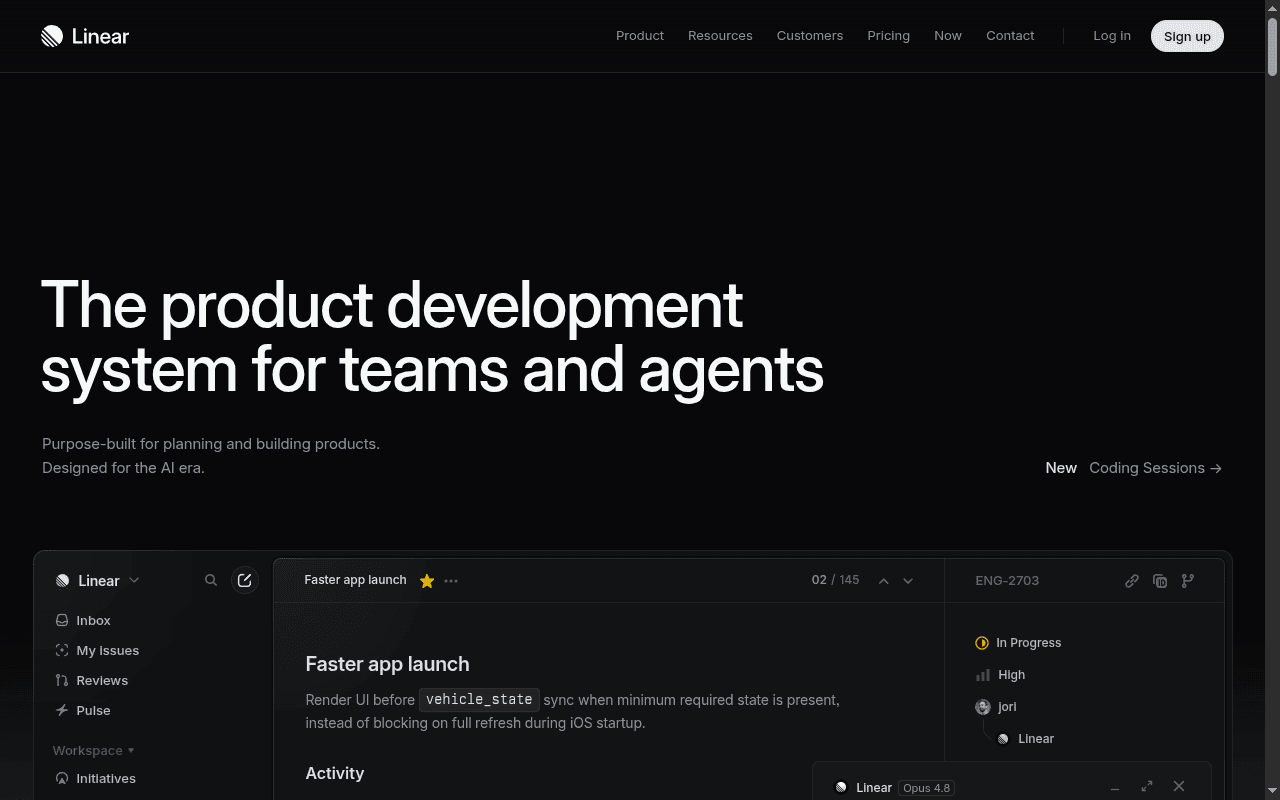
Multiple unexplained technical terms cluster in the hero and body without plain-language glosses: 'Coding Sessions', 'vehicle_state sync', 'PRDs', 'PRs', 'Triage Intelligence', 'Draft PR', 'useRideHistory.ts', 'RideHistoryPage.tsx', 'waitingStatusById map'. The hero subtext 'Designed for the AI era' and 'AI workflows at its core' are vague buzzwords that add a second layer of ambiguity. A non-technical founder, product manager, or journalist could not summarize the page without Googling several terms. The page also implicitly targets a dual audience (human teams AND AI agents) but uses developer-centric vocabulary exclusively.
Remove or relocate raw code-file names and internal ticket shorthand (vehicle_state sync, useRideHistory.ts) from the visible demo content, or add a one-line plain-language caption explaining what the demo shows. Replace 'PRDs to PRs' with 'product specs to code pull requests (PRs)' on first use. Ensure the hero copy is decodable by a non-engineering product manager without lookup.
CXL Institute, 'Landing Page Optimization' course (Peep Laja): Jargon in the hero section is a primary driver of immediate bounce; technical terms must be glossed inline if the page targets any non-specialist segment.
All findings
6 findings shown · 10 of 16 checks passing
Testimonials lack ICP-matching context
Social proof digest contains three anonymous quotes: 'You'll probably build a better product, just because of the craft that using Linear infuses on your brain.', 'Our speed is intense and Linear helps us be action biased.', 'Linear is excellent, just excellent. It has the right opinions for fast moving teams.' No names, roles, company names, company sizes, or industries are attributed to any of these testimonials.
Replace or augment anonymous quotes with attributed testimonials that include the speaker's name, job title (e.g., 'VP of Engineering'), company name, and ideally company size or industry. For a B2B product-development tool targeting engineering and product teams, ideal testimonials would come from CTOs, Heads of Product, or Engineering Managers at recognizable tech companies, explicitly stating their role and org context.
No objection-handling signals present near or anywhere on page
CTAs found: 'Sign up', '3.0 Build →', 'Get started', 'Download', 'Build'. No instances of 'no credit card required', 'cancel anytime', 'money-back guarantee', 'free trial', 'SOC 2', 'GDPR', 'free plan', or 'no setup fee' appear anywhere in the page body or social proof digest.
Add at least two objection-handling micro-copy elements directly adjacent to the primary CTA ('Sign up' or 'Get started'). High-impact options for this ICP include 'No credit card required' and 'Free plan available', or 'SOC 2 certified' and 'Cancel anytime'. Place them as subtext immediately below the CTA button to reduce friction at the moment of decision.
Jargon and insider terminology
Multiple unexplained technical terms cluster in the hero and body without plain-language glosses: 'Coding Sessions', 'vehicle_state sync', 'PRDs', 'PRs', 'Triage Intelligence', 'Draft PR', 'useRideHistory.ts', 'RideHistoryPage.tsx', 'waitingStatusById map'. The hero subtext 'Designed for the AI era' and 'AI workflows at its core' are vague buzzwords that add a second layer of ambiguity. A non-technical founder, product manager, or journalist could not summarize the page without Googling several terms. The page also implicitly targets a dual audience (human teams AND AI agents) but uses developer-centric vocabulary exclusively.
Remove or relocate raw code-file names and internal ticket shorthand (vehicle_state sync, useRideHistory.ts) from the visible demo content, or add a one-line plain-language caption explaining what the demo shows. Replace 'PRDs to PRs' with 'product specs to code pull requests (PRs)' on first use. Ensure the hero copy is decodable by a non-engineering product manager without lookup.
Single message focus
Five distinct CTAs appear: 'Sign up', '3.0 Build →', 'Get started', 'Download', 'Build'. These lead to at least three different actions (account creation, a versioned feature page, and an app download), fragmenting visitor attention. A first-time visitor must make a meta-decision about which CTA applies to them before they can act.
Consolidate to one primary CTA ('Get started free') and one secondary CTA ('Download the app') placed lower in the page hierarchy. Remove or relocate '3.0 Build →' to a changelog or feature announcement page rather than the main hero flow. Apply Fogg's principle: reduce the number of decisions required before the first conversion action.
Hero 5-second test
The product development system for teams and agents — WHAT (product development system) is reasonably clear, but WHO is ambiguous. 'Teams and agents' conflates human product teams with AI agents, leaving a first-time visitor uncertain whether this is for engineering managers, product managers, developers, or AI systems. No subhead exists to resolve the ambiguity.
Add a subhead that names the specific human audience explicitly, e.g., 'For product and engineering teams who ship software' before introducing the AI angle. The AI-agent dimension can be a secondary proof point, not part of the primary audience definition.
Named individuals present but lack role/company context
Image alt texts reference named individuals: 'Avatar of Karri', 'didier', 'lena', 'andreas', 'Steven', 'Ema', 'Meg'. These appear to be UI demo characters within product screenshots (e.g., 'karri · 4 min ago', 'jori · just now', 'didier 3:17 PM') rather than real customer testimonials or team members with roles and company affiliations. No founder bios, 'Meet the team' section, or named testimonials with titles are present.
Add a founder or team section with real named individuals, their titles, and photos to build personal trust. Alternatively, convert the anonymous testimonial quotes into attributed quotes with headshots, names, and roles. Even one founder attribution (e.g., 'Karri Saarinen, CEO & Co-founder') near the hero or CTA would meaningfully increase the Liking/familiarity signal.
Independent automated analysis by PageLint. Not affiliated with or endorsed by Linear. Findings reflect the public landing page as fetched on July 14, 2026 and may not match the current version.
How this was scored: 16 Clarity and Trust checks, each tied to a cited source (see all checks). No brand paid to be here. Linear can request a re-audit at [email protected]. The Full Report ($29 one-time) runs all 55 checks. The free landing page checker runs the same 16 checks on any public URL.
See how your page scores on the same 16 checks
Paste your URL and get a score out of 100, with each finding quoted from your page and the source behind the rule. About 60 seconds, free, no signup.
More project management teardowns
- Trello landing page teardown · 90/100
- Basecamp landing page teardown · 85/100
- Monday landing page teardown · 80/100
Related research
- Social proof without 'as seen in' logos · 7 min read
- The Trust lens: 8 checks for landing pages visitors believe · 12 min read
- Testimonials that convert: named, specific, outcome-first · 7 min read