Notion landing page teardown: what to change
Notion scores 76/100 on PageLint's quick copy audit — a solid result with clear room to tighten. Clarity is the stronger lens at 78/100, while Trust trails at 73/100. The biggest issue the engine flagged: “No purchase objection handlers near any CTA” (TR-6, high severity).
What to change
- 1 · TR-6 · highNo purchase objection handlers near any CTA
The primary CTAs are 'Get Notion free', 'Request a demo', and 'Download for Mac'. The only adjacent copy near the final CTA section reads: 'Try for free. Get started on Notion. Your AI workspace with built-in agents.' No signals found for: 'no credit card required', 'cancel anytime', 'money-back guarantee', '14-day free trial', 'SOC 2', 'GDPR', 'free plan', or 'no setup fee' anywhere in the page content.
Add at least 2 objection-handling micro-copy elements directly beneath or adjacent to each primary CTA. For example, place 'No credit card required · Cancel anytime' under 'Get Notion free', and add 'SOC 2 certified · GDPR compliant' near the 'Request a demo' CTA. This reduces friction and anxiety at the moment of highest purchase intent.
CXL Institute anxiety lens research; Cialdini, R. (2001). Influence: The Psychology of Persuasion — reducing perceived risk at the decision point lowers psychological reactance and increases conversion likelihood.
- 2 · TR-4 · mediumAuthority signals verifiable
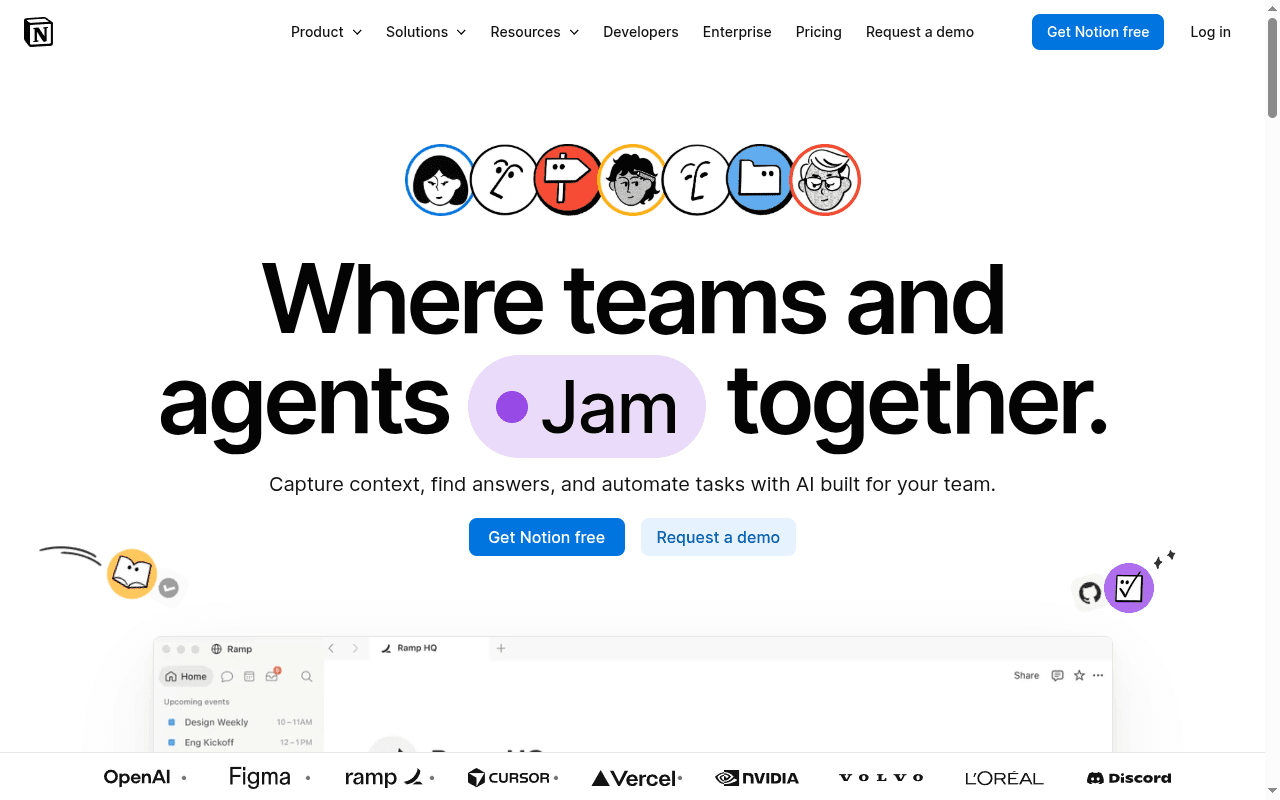
Press/authority claim detected (Trusted by) but the logos/text are not linked to verifiable sources.
Wrap each press logo or 'Featured in' badge in an <a href> pointing to the actual article or brand page. Unlinked authority claims invite scepticism — the reader cannot verify them.
Cialdini, Influence, Ch. 5 (Authority); Ogilvy
- 3 · CL-3 · mediumHero 5-second test
Hero H1: 'Where teams and agents Jam together.' Subhead: 'Capture context, find answers, and automate tasks with AI built for your team.' The WHAT is unclear in 5 seconds — 'Jam together' is a vague metaphor that does not communicate whether this is a workspace, a chat tool, a project manager, or an AI assistant. The subhead adds partial clarity but requires reading. WHO ('your team') is broadly stated but not specific enough to be meaningful.
Rewrite the H1 to state the concrete product category and primary benefit in plain language — e.g., 'The AI workspace where your team writes, plans, and automates work in one place.' The subhead can then add specificity. Avoid metaphorical verbs ('Jam') in the hero when the product category is not yet established in the visitor's mind.
Ogilvy, 'Ogilvy on Advertising' (1983): 'The headline is the most important element in most advertisements. It is the telegram which decides the reader whether to read the copy.' A headline that fails to communicate the product category wastes the primary impression.
Before → after
PageLint drafted these rewrites from the audited page text and the findings above. Treat them as proposals for Notion to test. Any claim in them must match the company’s real terms.
"Jam together" is a metaphor. The new line names the category and the benefit (CL-3).
Glosses "agents" at first use (CL-5).
Self-serve is the main path. Sales-led and download actions become secondary (CL-6).
Expected impact
These rewrites target CL-3, CL-5, CL-6. If they ship, those checks should stop failing on a re-audit, which would lift the 76/100 score. We have not re-scored them yet and we do not claim a conversion lift, because we have no conversion data for Notion.
All findings
7 findings shown · 9 of 16 checks passing
No purchase objection handlers near any CTA
The primary CTAs are 'Get Notion free', 'Request a demo', and 'Download for Mac'. The only adjacent copy near the final CTA section reads: 'Try for free. Get started on Notion. Your AI workspace with built-in agents.' No signals found for: 'no credit card required', 'cancel anytime', 'money-back guarantee', '14-day free trial', 'SOC 2', 'GDPR', 'free plan', or 'no setup fee' anywhere in the page content.
Add at least 2 objection-handling micro-copy elements directly beneath or adjacent to each primary CTA. For example, place 'No credit card required · Cancel anytime' under 'Get Notion free', and add 'SOC 2 certified · GDPR compliant' near the 'Request a demo' CTA. This reduces friction and anxiety at the moment of highest purchase intent.
Authority signals verifiable
Press/authority claim detected (Trusted by) but the logos/text are not linked to verifiable sources.
Wrap each press logo or 'Featured in' badge in an <a href> pointing to the actual article or brand page. Unlinked authority claims invite scepticism — the reader cannot verify them.
Hero 5-second test
Hero H1: 'Where teams and agents Jam together.' Subhead: 'Capture context, find answers, and automate tasks with AI built for your team.' The WHAT is unclear in 5 seconds — 'Jam together' is a vague metaphor that does not communicate whether this is a workspace, a chat tool, a project manager, or an AI assistant. The subhead adds partial clarity but requires reading. WHO ('your team') is broadly stated but not specific enough to be meaningful.
Rewrite the H1 to state the concrete product category and primary benefit in plain language — e.g., 'The AI workspace where your team writes, plans, and automates work in one place.' The subhead can then add specificity. Avoid metaphorical verbs ('Jam') in the hero when the product category is not yet established in the visitor's mind.
Jargon and insider terminology
Hero H1 uses 'agents' without definition — 'Where teams and agents Jam together.' The term 'agents' in the AI sense (autonomous AI workers) is not plain language for a broad business audience. The body clusters multiple unexplained technical terms: 'Q&A agents,' 'Task routing agents,' 'Reporting agents,' 'Custom Agent,' 'AI enterprise search,' 'knowledge base' — all appear without plain-language glosses. The page also references 'Resolve support tickets in Slack' and 'Respond to security alerts faster,' implying a technical/ops audience, while simultaneously targeting general teams ('your team,' '100M users'). This dual-audience tension means the AI-agent vocabulary serves one segment but alienates another.
Add a one-sentence plain-language explanation immediately after the first use of 'agents' in the hero — e.g., 'Agents are AI assistants that handle repetitive work automatically.' For each agent type in the body, include a parenthetical or tooltip explaining what it does in non-technical terms. Resolve the dual-audience tension by either narrowing the target audience or providing a segmentation path ('For developers / For business teams').
Single message focus
The page presents at least three distinct CTAs leading to different outcomes: 'Get Notion free' (self-serve signup), 'Request a demo' (sales-led enterprise), and 'Download for Mac' (desktop app install). A fourth offer, 'Notion Mail,' appears at the bottom, introducing a separate product entirely. Visitors face a meta-decision: am I signing up for a free account, booking a sales call, downloading an app, or exploring a mail product?
Establish one primary CTA hierarchy: make 'Get Notion free' the dominant CTA for the majority self-serve audience, demote 'Request a demo' to a secondary text link styled for enterprise visitors, and move 'Download for Mac' to a post-signup or product page. Remove or relocate the 'Notion Mail' mention to a separate product page or a clearly labeled 'Also from Notion' section to avoid fragmenting the primary message.
Testimonials lack ICP-specific attribution
All testimonials are anonymous quotes with no named individuals, roles, company names, or industries: '"Agents get created in three minutes between meetings, then hours of manual operational work disappear."', '"Notion understands that you can solve a lot of problems with one tool."', '"Notion has been the most powerful and impactful way to streamline our workflow."', '"Using the most AI-native tools like Notion is an important competitive advantage for us."' — none include a name, title, company, or industry signal. The social proof digest confirms no named individuals with roles or company affiliations appear anywhere on the page.
Replace anonymous quotes with attributed testimonials that include the speaker's full name, job title, company name, and ideally company size or industry (e.g., 'Jane Smith, Head of Operations, Acme Corp (Series B, 200 employees)'). Prioritize testimonials from roles matching Notion's ICP — team leads, ops managers, or knowledge workers at mid-market or enterprise companies — so visitors self-identify with the social proof.
No named individuals with photos or roles visible
The social proof digest and body text contain no named individuals, no team section, no founder attribution, and no headshot alt text patterns referencing real people. Image alt texts reference 'Search results showing information from Slack, Google Drive, and Jira | Forbes | OpenAI' — product UI and logo imagery only. All testimonials are anonymous. No 'Meet the team' or founder byline is present.
Introduce at least one named human face with a real photo, title, and company affiliation — ideally a customer testimonial with a headshot, or a founder/team section. Named, attributed faces activate the Liking principle by creating familiarity and perceived similarity, meaningfully increasing visitor trust.
Independent automated analysis by PageLint. Not affiliated with or endorsed by Notion. Findings reflect the public landing page as fetched on July 14, 2026 and may not match the current version.
How this was scored: 16 Clarity and Trust checks, each tied to a cited source (see all checks). No brand paid to be here. Notion can request a re-audit at [email protected]. The Full Report ($29 one-time) runs all 55 checks. The free landing page checker runs the same 16 checks on any public URL.
See how your page scores on the same 16 checks
Paste your URL and get a score out of 100, with each finding quoted from your page and the source behind the rule. About 60 seconds, free, no signup.
More project management teardowns
- Trello landing page teardown · 90/100
- Basecamp landing page teardown · 85/100
- Monday landing page teardown · 80/100