Stripe landing page teardown: what to change
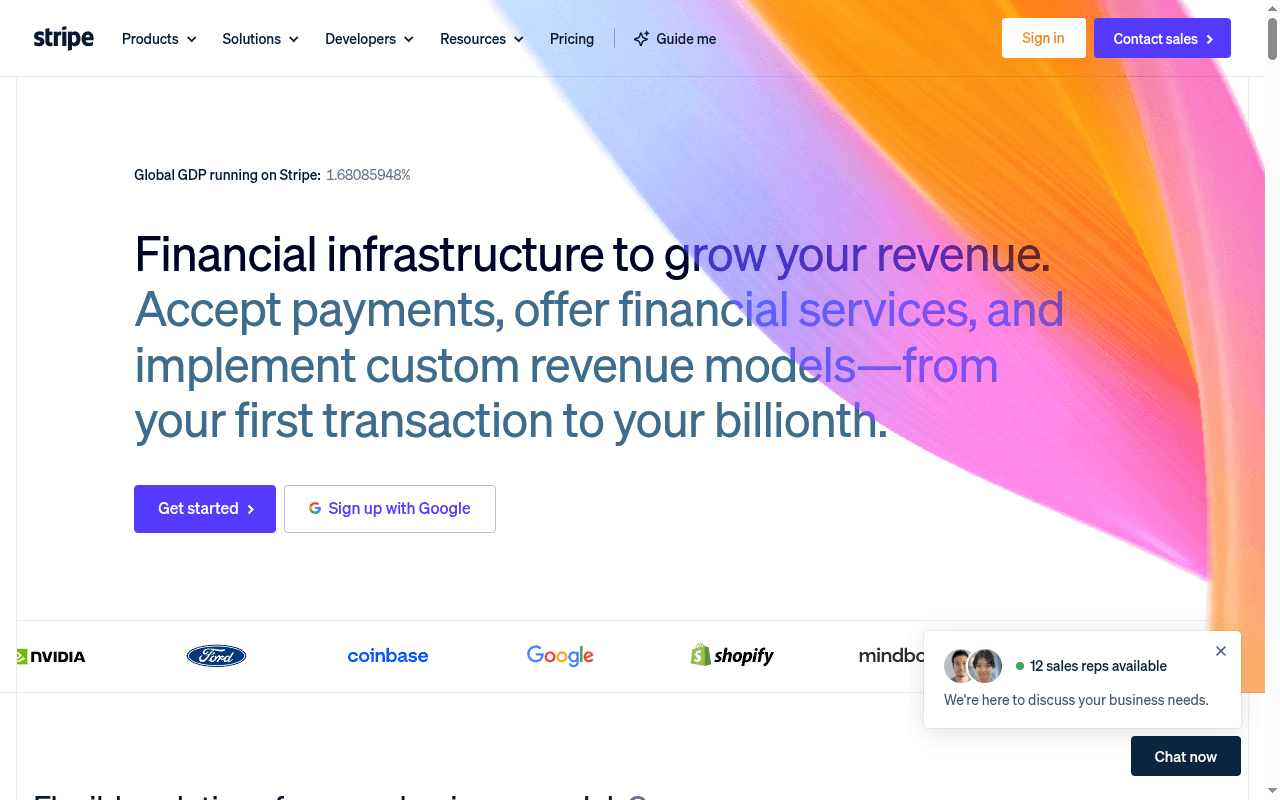
Stripe scores 83/100 on PageLint's quick copy audit — a solid result with clear room to tighten. Trust is the stronger lens at 84/100, while Clarity trails at 82/100. The biggest issue the engine flagged: “Objections handled near CTA” (TR-6, high severity).
What to change
- 1 · TR-6 · highObjections handled near CTA
Primary CTAs are 'Start now', 'Get started', and 'Sign up with Google'. No objection-handling signals ('no credit card required', 'cancel anytime', 'money-back guarantee', '14-day free trial', 'SOC 2', 'GDPR', 'free plan', 'no setup fee') are present in the body text, section headings, or social proof digest within proximity of any CTA.
Add at least 2 objection-handlers directly beneath or adjacent to the primary 'Get started' CTA — for example, 'No credit card required' and 'Cancel anytime' as microcopy below the button, or a trust badge row including SOC 2 and GDPR compliance icons to reduce signup anxiety at the moment of decision.
CXL Institute anxiety lens research; Cialdini, R. (2001). Influence: The Psychology of Persuasion — reducing perceived risk at the point of commitment lowers friction and increases conversion.
- 2 · CL-5 · mediumJargon and insider terminology
'Financial infrastructure', 'custom revenue models', 'card issuing program' — three distinct insider terms clustered in the hero and primary CTA with no plain-language gloss. 'Financial infrastructure' is an internal/industry framing that a non-technical founder or SMB owner would not immediately decode. 'Card issuing program' appears as a standalone CTA ('Create a card issuing program') with zero contextual explanation on the page.
Replace or gloss 'financial infrastructure' in the H1 with a plain-language equivalent (e.g., 'the payments and banking tools that power your business'). Add a one-line descriptor beneath the 'Create a card issuing program' CTA explaining what card issuing means in plain terms (e.g., 'Launch your own branded debit or credit card'). Stripe's audience spans non-technical founders and SMB operators alongside developers — jargon that only developers or CFOs parse fluently creates friction for the broader audience the page implicitly targets.
Ogilvy, 'Ogilvy on Advertising' (1983), ch. 'How to Write Potent Copy': 'Never use jargon words like reconceptualize… they are hallmarks of a pretentious ass.' CXL Institute conversion research also identifies unexplained technical terminology in hero copy as a primary clarity killer that increases bounce rate.
- 3 · CL-6 · mediumSingle message focus
Five distinct CTA instances appear: 'Start now', 'Get started', 'Sign up with Google', 'Create a card issuing program', 'Get started'. While 'Start now', 'Get started', and 'Sign up with Google' converge on account creation, 'Create a card issuing program' is a divergent CTA leading to a separate product path. This forces a meta-decision: is this page for signing up for Stripe generally, or for launching a card issuing program specifically?
Consolidate to one primary CTA ('Get started') and one clearly subordinate secondary CTA ('Explore card issuing →') styled visually as a secondary action (ghost button or text link). The card issuing CTA should live in a dedicated product section lower on the page, not compete at the hero level. Ogilvy's principle of one dominant offer per ad applies directly: splitting attention between account signup and a specific product program dilutes conversion on both.
Ogilvy, 'Confessions of an Advertising Man' (1963): 'A good advertisement is one which sells the product without drawing attention to itself' — competing CTAs draw attention to the interface rather than the offer. CXL Institute A/B test research consistently shows single-CTA pages outperform multi-CTA pages by 13–25% on primary conversion goals.
Before → after
PageLint drafted these rewrites from the audited page text and the findings above. Treat them as proposals for Stripe to test. Any claim in them must match the company’s real terms.
Names the three things Stripe does and drops the insider term "financial infrastructure" (CL-3, CL-5).
One primary action and one clearly secondary link instead of five competing buttons (CL-6).
The page has no objection handler near the CTA (TR-6). Use wording that matches Stripe's real terms.
Expected impact
These rewrites target CL-3, CL-5, CL-6, TR-6. If they ship, those checks should stop failing on a re-audit, which would lift the 83/100 score. We have not re-scored them yet and we do not claim a conversion lift, because we have no conversion data for Stripe.
All findings
5 findings shown · 11 of 16 checks passing
Objections handled near CTA
Primary CTAs are 'Start now', 'Get started', and 'Sign up with Google'. No objection-handling signals ('no credit card required', 'cancel anytime', 'money-back guarantee', '14-day free trial', 'SOC 2', 'GDPR', 'free plan', 'no setup fee') are present in the body text, section headings, or social proof digest within proximity of any CTA.
Add at least 2 objection-handlers directly beneath or adjacent to the primary 'Get started' CTA — for example, 'No credit card required' and 'Cancel anytime' as microcopy below the button, or a trust badge row including SOC 2 and GDPR compliance icons to reduce signup anxiety at the moment of decision.
Jargon and insider terminology
'Financial infrastructure', 'custom revenue models', 'card issuing program' — three distinct insider terms clustered in the hero and primary CTA with no plain-language gloss. 'Financial infrastructure' is an internal/industry framing that a non-technical founder or SMB owner would not immediately decode. 'Card issuing program' appears as a standalone CTA ('Create a card issuing program') with zero contextual explanation on the page.
Replace or gloss 'financial infrastructure' in the H1 with a plain-language equivalent (e.g., 'the payments and banking tools that power your business'). Add a one-line descriptor beneath the 'Create a card issuing program' CTA explaining what card issuing means in plain terms (e.g., 'Launch your own branded debit or credit card'). Stripe's audience spans non-technical founders and SMB operators alongside developers — jargon that only developers or CFOs parse fluently creates friction for the broader audience the page implicitly targets.
Single message focus
Five distinct CTA instances appear: 'Start now', 'Get started', 'Sign up with Google', 'Create a card issuing program', 'Get started'. While 'Start now', 'Get started', and 'Sign up with Google' converge on account creation, 'Create a card issuing program' is a divergent CTA leading to a separate product path. This forces a meta-decision: is this page for signing up for Stripe generally, or for launching a card issuing program specifically?
Consolidate to one primary CTA ('Get started') and one clearly subordinate secondary CTA ('Explore card issuing →') styled visually as a secondary action (ghost button or text link). The card issuing CTA should live in a dedicated product section lower on the page, not compete at the hero level. Ogilvy's principle of one dominant offer per ad applies directly: splitting attention between account signup and a specific product program dilutes conversion on both.
Hero 5-second test
Financial infrastructure to grow your revenue. Accept payments, offer financial services, and implement custom revenue models—from your first transaction to your billionth.
WHAT is reasonably clear (payments and financial services platform), but WHO is undefined — 'your first transaction to your billionth' hints at scale range but does not name the audience (developers, startups, enterprises, marketplaces). Add a brief qualifier such as 'for startups and enterprises' or 'built for developers and finance teams' to anchor the audience immediately in the hero.
Real human faces present
Named individuals with roles and company affiliations appear in testimonials: Kurtis Moyer (Lead Product Manager of Payments, Mindbody), Laura Collinson (Director of Fintech, Jobber), Seth McMillan (Engineering Manager, Substack), Dax Dasilva (Founder and CEO, Lightspeed). Image alt texts describe aerial and exterior architectural/abstract photography ('Aerial view of a street intersection', 'Exterior view of a clothing boutique') with no mention of headshots or human faces.
Add headshot photos alongside each named testimonial and consider a 'Meet the team' or founder section with real photos. Ensure alt text for testimonial images explicitly references the person's name and role to reinforce authenticity signals for both users and accessibility tools.
Independent automated analysis by PageLint. Not affiliated with or endorsed by Stripe. Findings reflect the public landing page as fetched on July 14, 2026 and may not match the current version.
How this was scored: 16 Clarity and Trust checks, each tied to a cited source (see all checks). No brand paid to be here. Stripe can request a re-audit at [email protected]. The Full Report ($29 one-time) runs all 55 checks. The free landing page checker runs the same 16 checks on any public URL.
See how your page scores on the same 16 checks
Paste your URL and get a score out of 100, with each finding quoted from your page and the source behind the rule. About 60 seconds, free, no signup.
More payments and commerce teardowns
- Shopify landing page teardown · 76/100