Asana landing page teardown: what to change
Asana scores 66/100 on PageLint's quick copy audit — a mixed result — strong in places, leaky in others. Trust is the stronger lens at 72/100, while Clarity trails at 60/100. The biggest issue the engine flagged: “Hero 5-second test” (CL-3, high severity).
What to change
- 1 · CL-3 · highHero 5-second test
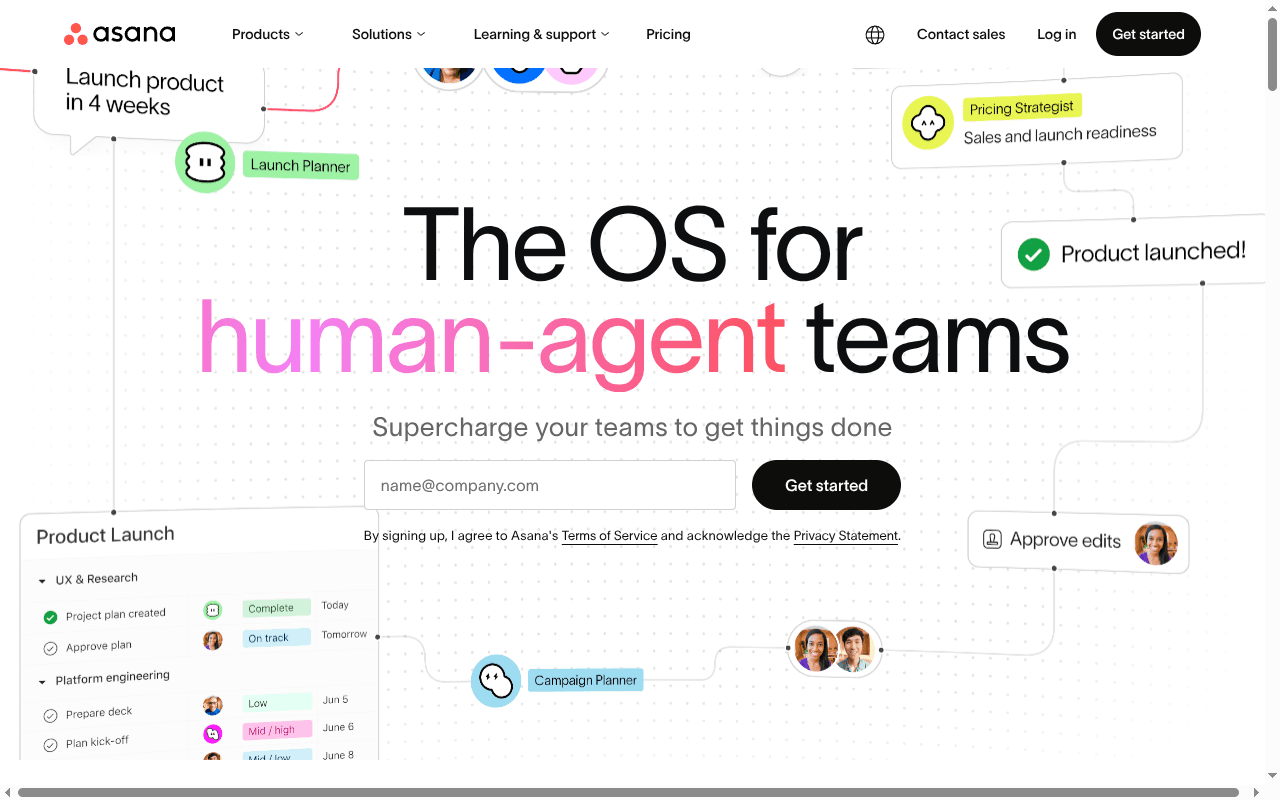
The OS for human-agent teams / Supercharge your teams to get things done — 'OS for human-agent teams' does not communicate what the product does (project management? workflow automation? an operating system?) and 'human-agent teams' is undefined jargon that excludes anyone unfamiliar with AI-agent terminology. A first-time visitor cannot determine WHAT Asana does or WHO it is for within 5 seconds.
Rewrite the H1 to name the product category and the primary user plainly, e.g., 'The AI-powered work management platform for enterprise teams' or 'Manage projects, automate workflows, and coordinate AI agents — all in one place.' The subhead 'Supercharge your teams to get things done' adds no specificity; replace it with a concrete outcome such as 'So every team hits deadlines, reduces manual work, and keeps every stakeholder aligned.'
Ogilvy, 'Ogilvy on Advertising' (1983): 'On the average, five times as many people read the headline as read the body copy. Unless your headline sells your product, you have wasted 90 percent of your money.'
- 2 · CL-5 · highJargon and insider terminology
'Asana Work Graph®', 'A neural network of everything your company is doing', 'Multiplayer', 'Shared memory', 'Enterprise governance', 'scoped permissions', 'audit trail', 'GTM Sequencing', 'Dependency Mapping', 'Artifact Auditing', 'Messaging Compliance' — multiple unexplained technical and proprietary terms cluster throughout the page, several appearing in the hero section or immediately below it. 'Work Graph®' is a proprietary concept with no plain-language gloss at point of first use. 'GTM Sequencing' and 'Artifact Auditing' are insider terms that even many target users would need to decode. The page simultaneously targets enterprise IT/governance buyers ('scoped permissions', 'audit trail', 'cost constraints') and operational team leads ('hit every deadline', 'keep work moving'), using each audience's vocabulary without bridging the gap for the other.
1) Define 'Work Graph®' immediately on first use with a one-sentence plain-language explanation (e.g., 'Work Graph® — Asana's connected map of every task, person, goal, and dependency across your company'). 2) Replace or gloss skill labels like 'GTM Sequencing', 'Artifact Auditing', and 'Dependency Mapping' with outcome-first language before the label, e.g., 'Dependency Mapping — automatically flags tasks that will block others.' 3) Resolve the dual-audience vocabulary tension by choosing a primary audience for the hero and moving governance/IT language to a dedicated section lower on the page.
Schwartz, 'Breakthrough Advertising' (1966): copy must meet the prospect at their exact level of awareness and vocabulary — introducing proprietary or technical language before establishing shared context breaks the reader's identification with the message.
- 3 · TR-2 · highTestimonials do not match ICP
Only one testimonial is present across the entire page: 'By building scalable workflows and leveraging AI with intention, we've been able to increase visibility and speed while focusing our energy on strategic execution. Simone Williams, Chief Digital, Technology & Business Development Officer, COS.' The logo strip includes Amazon, Accenture, Johnson & Johnson, Dell, and Merck — large enterprise brands — but no additional named testimonials with roles or situational context are present. The page targets 'human-agent teams' broadly, with product lines spanning IT, HR, agencies, and developers, yet only one testimonial exists and it comes from a single executive at 'COS' (an ambiguous company name with no industry context provided).
Add at least 2–3 testimonials that explicitly match distinct ICP segments (e.g., a VP of Operations at a mid-market SaaS company, an IT Director at an enterprise, an agency project manager). Each testimonial should include role, company type or size, and a specific outcome tied to the product's value proposition. This activates Cialdini's similarity amplifier — prospects trust peers who mirror their own situation.
Cialdini, R. (2001). Influence: The Psychology of Persuasion. Ch. 4 — Social Proof: the similarity amplifier principle states that people follow the lead of similar others, making role and industry specificity in testimonials critical for persuasion.
All findings
7 findings shown · 9 of 16 checks passing
Hero 5-second test
The OS for human-agent teams / Supercharge your teams to get things done — 'OS for human-agent teams' does not communicate what the product does (project management? workflow automation? an operating system?) and 'human-agent teams' is undefined jargon that excludes anyone unfamiliar with AI-agent terminology. A first-time visitor cannot determine WHAT Asana does or WHO it is for within 5 seconds.
Rewrite the H1 to name the product category and the primary user plainly, e.g., 'The AI-powered work management platform for enterprise teams' or 'Manage projects, automate workflows, and coordinate AI agents — all in one place.' The subhead 'Supercharge your teams to get things done' adds no specificity; replace it with a concrete outcome such as 'So every team hits deadlines, reduces manual work, and keeps every stakeholder aligned.'
Jargon and insider terminology
'Asana Work Graph®', 'A neural network of everything your company is doing', 'Multiplayer', 'Shared memory', 'Enterprise governance', 'scoped permissions', 'audit trail', 'GTM Sequencing', 'Dependency Mapping', 'Artifact Auditing', 'Messaging Compliance' — multiple unexplained technical and proprietary terms cluster throughout the page, several appearing in the hero section or immediately below it. 'Work Graph®' is a proprietary concept with no plain-language gloss at point of first use. 'GTM Sequencing' and 'Artifact Auditing' are insider terms that even many target users would need to decode. The page simultaneously targets enterprise IT/governance buyers ('scoped permissions', 'audit trail', 'cost constraints') and operational team leads ('hit every deadline', 'keep work moving'), using each audience's vocabulary without bridging the gap for the other.
1) Define 'Work Graph®' immediately on first use with a one-sentence plain-language explanation (e.g., 'Work Graph® — Asana's connected map of every task, person, goal, and dependency across your company'). 2) Replace or gloss skill labels like 'GTM Sequencing', 'Artifact Auditing', and 'Dependency Mapping' with outcome-first language before the label, e.g., 'Dependency Mapping — automatically flags tasks that will block others.' 3) Resolve the dual-audience vocabulary tension by choosing a primary audience for the hero and moving governance/IT language to a dedicated section lower on the page.
Testimonials do not match ICP
Only one testimonial is present across the entire page: 'By building scalable workflows and leveraging AI with intention, we've been able to increase visibility and speed while focusing our energy on strategic execution. Simone Williams, Chief Digital, Technology & Business Development Officer, COS.' The logo strip includes Amazon, Accenture, Johnson & Johnson, Dell, and Merck — large enterprise brands — but no additional named testimonials with roles or situational context are present. The page targets 'human-agent teams' broadly, with product lines spanning IT, HR, agencies, and developers, yet only one testimonial exists and it comes from a single executive at 'COS' (an ambiguous company name with no industry context provided).
Add at least 2–3 testimonials that explicitly match distinct ICP segments (e.g., a VP of Operations at a mid-market SaaS company, an IT Director at an enterprise, an agency project manager). Each testimonial should include role, company type or size, and a specific outcome tied to the product's value proposition. This activates Cialdini's similarity amplifier — prospects trust peers who mirror their own situation.
No objection-handling signals near any CTA
The primary CTAs are 'Get started' and 'View demo', appearing multiple times across the page. No objection-handling language is found anywhere in proximity to these CTAs — no 'no credit card required', 'cancel anytime', 'money-back guarantee', 'free trial', 'SOC 2', 'GDPR', 'free plan', or 'no setup fee' signals appear anywhere in the page content or social proof digest. The closest trust signal is the Gartner Magic Quadrant mention ('A Leader in the 2025 Gartner Magic Quadrant for Collaborative Work Management three years in a row'), which addresses credibility but not purchase anxiety.
Place at least 2 objection-handling micro-copy elements directly beneath or adjacent to each primary CTA button. For example, add 'No credit card required · Free plan available · Cancel anytime' as a sub-line under 'Get started'. For enterprise CTAs, add 'SOC 2 certified · GDPR compliant' to reduce security objections. This directly reduces friction at the moment of decision.
Single dominant H1
Found 2 H1 tags: ['The OS for human-agent teams', 'AI Teammates']
Use only one H1 per page. Demote secondary H1s to H2.
Single message focus
CTAs present: 'Get started', 'View demo', 'Download app' (appears twice), 'Get started' (repeated twice more), plus 'Learn more' in the AI Teammates section. The page surfaces at least three functionally distinct actions — signing up ('Get started'), watching a demo ('View demo'), and downloading an app ('Download app') — without hierarchy or guidance on which action fits which visitor type. 'View demo' and 'Get started' target different stages of buyer readiness, creating a meta-decision for the visitor.
Establish a single primary CTA ('Get started' or 'View demo') as the dominant action in the hero, and demote secondary CTAs visually (ghost button or text link). Remove the duplicate 'Download app' buttons from the hero area or relocate them to a dedicated mobile-app section. Use CTA copy that signals the next step clearly, e.g., 'Start free — no credit card required' vs. 'See a 3-minute demo' so visitors self-select without confusion.
Limited named human presence; photo authenticity unverifiable
Only one named individual appears in the content: 'Simone Williams, Chief Digital, Technology & Business Development Officer, COS.' No team section, founder attribution, or 'Meet the team' content is present. Image alt texts reference product UI screenshots and a network diagram, not headshots. No additional named customers or team members are identified in the social proof digest.
Add a founder or leadership section with named individuals, titles, and real photos. Supplement with 2–3 named customer testimonials that include headshots and company affiliations. This builds familiarity and liking, which Cialdini identifies as a core trust driver. Even a brief 'Built by' or 'Trusted by people like you' section with real faces and names would meaningfully increase perceived authenticity.
Independent automated analysis by PageLint. Not affiliated with or endorsed by Asana. Findings reflect the public landing page as fetched on July 17, 2026 and may not match the current version.
How this was scored: 16 Clarity and Trust checks, each tied to a cited source (see all checks). No brand paid to be here. Asana can request a re-audit at [email protected]. The Full Report ($29 one-time) runs all 55 checks. The free landing page checker runs the same 16 checks on any public URL.
See how your page scores on the same 16 checks
Paste your URL and get a score out of 100, with each finding quoted from your page and the source behind the rule. About 60 seconds, free, no signup.
Compare Asana
- Asana vs Monday: landing page copy compared · 66 vs 80 for Monday
- Trello vs Asana: landing page copy compared · 66 vs 90 for Trello
- Basecamp vs Asana: landing page copy compared · 66 vs 85 for Basecamp
- Jira vs Asana: landing page copy compared · 66 vs 79 for Jira
More project management teardowns
- Trello landing page teardown · 90/100
- Basecamp landing page teardown · 85/100
- Monday landing page teardown · 80/100