Basecamp landing page teardown: what to change
Basecamp scores 85/100 on PageLint's quick copy audit — one of the strongest pages we have run through the engine. Clarity is the stronger lens at 86/100, while Trust trails at 83/100. The biggest issue the engine flagged: “Jargon and insider terminology” (CL-5, medium severity).
What to change
- 1 · CL-5 · mediumJargon and insider terminology
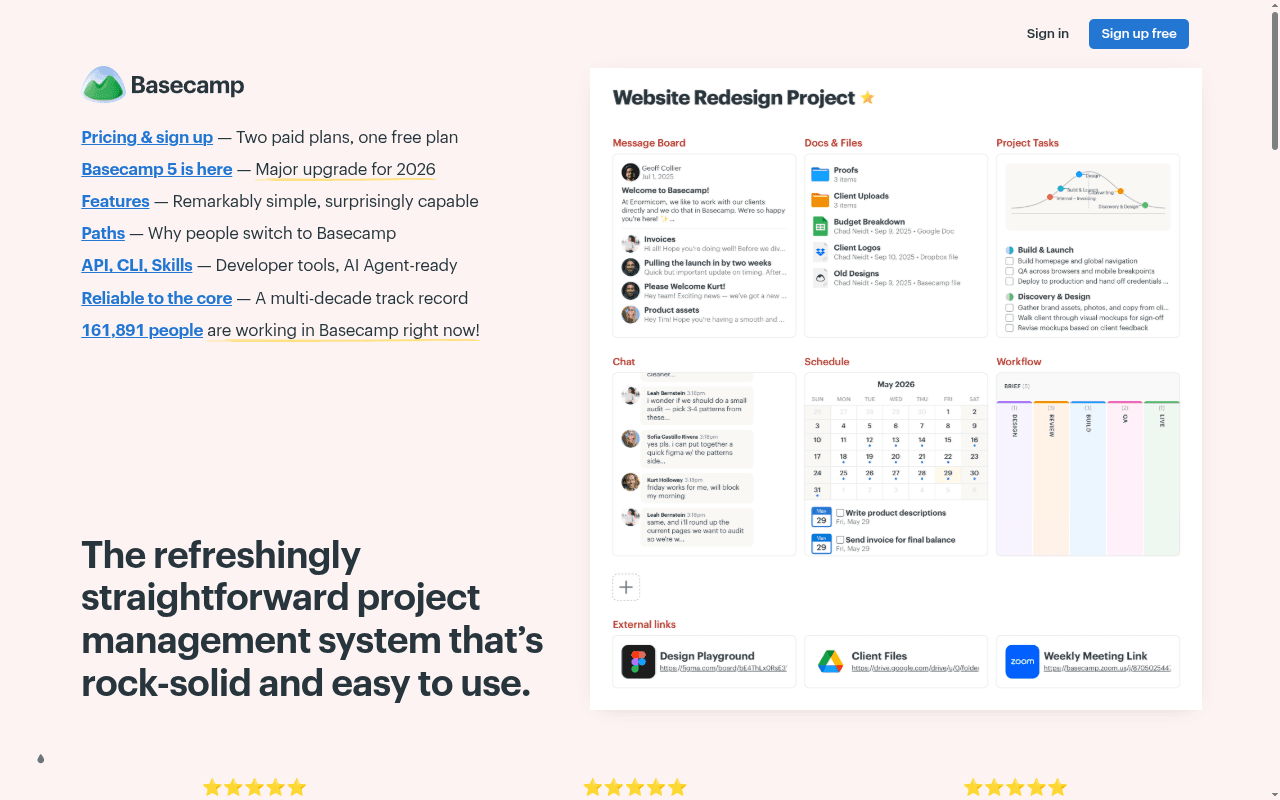
Navigation cluster: 'API, CLI, Skills — Developer tools, AI Agent-ready' and 'Basecamp 5 is here — Major upgrade for 2026' alongside 'Paths — Why people switch to Basecamp'. The nav simultaneously uses developer-specific terms (API, CLI, AI Agent-ready) and plain-language positioning ('refreshingly straightforward', 'easy to use even the 80-year-olds'). The page explicitly targets a dual audience — technical developers and non-technical users (church committees, university staff) — but the hero navigation uses only the developer vocabulary without any plain-language gloss. 'CLI' and 'AI Agent-ready' are unexplained and appear above the fold in the nav bar.
Either move the developer-tools nav item below the fold into a dedicated developer section, or add a plain-language parenthetical in the nav itself (e.g., 'API & CLI — for developers building on Basecamp'). 'AI Agent-ready' especially needs a one-line explanation since it is a marketing claim that means different things to different audiences. The hero copy and testimonials signal a non-technical audience; the nav contradicts that signal and creates vocabulary tension.
Ogilvy, 'Ogilvy on Advertising' (1983), Ch. 1: 'The consumer is not a moron, she is your wife' — write for the least-informed likely reader, not the most-informed; CXL Institute research on audience-vocabulary mismatch reducing conversion rates.
- 2 · TR-2 · mediumTestimonials match target audience
Testimonials include: Patrick Sheffield (Moore Communications Group), Aaron Bingaman (Penn State Office of Emergency Management), Shannon Kropf (Full Sail University), John Drover (Roebothan McKay Marshall), Pedro Lopes (Coimbra Genomics), Kelly Hunter (Chamber Nation), Blake Rider (St. Stephen's Episcopal Church), Anthony Clark (Clark Partners Realty Group), Kevin Duffy (TRUE Marketing). Names and company affiliations are present, but job titles/roles are absent for all testimonials. The ICP appears to be teams and businesses needing project management, yet the mix includes a church committee and a university emergency management office alongside marketing agencies and realty groups — creating a broad, somewhat unfocused signal.
Add job titles/roles to each testimonial (e.g., 'Patrick Sheffield, Director of Operations, Moore Communications Group') so visitors can self-identify with the social proof. Prioritize testimonials from the core ICP — small-to-mid-size business teams and agencies — and either remove or separate non-business use cases (church, emergency management) to a dedicated 'all kinds of teams' section rather than the primary testimonial strip.
Cialdini, R. (2001). Influence: The Psychology of Persuasion. Ch. 4 — Social proof is most powerful when the observer perceives similarity to the person providing the proof (the 'similarity amplifier').
- 3 · TR-1 · lowLegal trust links
Privacy Policy found, but no Terms of Service link
Add Terms of Service link (baseline trust signal).
GDPR/CCPA compliance; Baymard Institute trust research
All findings
7 findings shown · 9 of 16 checks passing
Jargon and insider terminology
Navigation cluster: 'API, CLI, Skills — Developer tools, AI Agent-ready' and 'Basecamp 5 is here — Major upgrade for 2026' alongside 'Paths — Why people switch to Basecamp'. The nav simultaneously uses developer-specific terms (API, CLI, AI Agent-ready) and plain-language positioning ('refreshingly straightforward', 'easy to use even the 80-year-olds'). The page explicitly targets a dual audience — technical developers and non-technical users (church committees, university staff) — but the hero navigation uses only the developer vocabulary without any plain-language gloss. 'CLI' and 'AI Agent-ready' are unexplained and appear above the fold in the nav bar.
Either move the developer-tools nav item below the fold into a dedicated developer section, or add a plain-language parenthetical in the nav itself (e.g., 'API & CLI — for developers building on Basecamp'). 'AI Agent-ready' especially needs a one-line explanation since it is a marketing claim that means different things to different audiences. The hero copy and testimonials signal a non-technical audience; the nav contradicts that signal and creates vocabulary tension.
Testimonials match target audience
Testimonials include: Patrick Sheffield (Moore Communications Group), Aaron Bingaman (Penn State Office of Emergency Management), Shannon Kropf (Full Sail University), John Drover (Roebothan McKay Marshall), Pedro Lopes (Coimbra Genomics), Kelly Hunter (Chamber Nation), Blake Rider (St. Stephen's Episcopal Church), Anthony Clark (Clark Partners Realty Group), Kevin Duffy (TRUE Marketing). Names and company affiliations are present, but job titles/roles are absent for all testimonials. The ICP appears to be teams and businesses needing project management, yet the mix includes a church committee and a university emergency management office alongside marketing agencies and realty groups — creating a broad, somewhat unfocused signal.
Add job titles/roles to each testimonial (e.g., 'Patrick Sheffield, Director of Operations, Moore Communications Group') so visitors can self-identify with the social proof. Prioritize testimonials from the core ICP — small-to-mid-size business teams and agencies — and either remove or separate non-business use cases (church, emergency management) to a dedicated 'all kinds of teams' section rather than the primary testimonial strip.
Legal trust links
Privacy Policy found, but no Terms of Service link
Add Terms of Service link (baseline trust signal).
Hero 5-second test
The refreshingly straightforward project management system that's rock-solid and easy to use.
WHAT (project management tool) is clear within 5 seconds. WHO is not — the hero gives no signal about whether this is for agencies, enterprises, small teams, churches, or universities. The testimonials below reveal a wildly diverse audience (Penn State emergency management, a church committee, a genomics firm), but the hero itself carries no audience signal. Add a short qualifier to the headline or subhead — e.g., 'for teams of 5 to 500' or 'used by agencies, nonprofits, and growing businesses' — so first-time visitors self-identify immediately.
Single message focus
CTAs present: 'Sign up free' (appears twice), 'Try Basecamp free', and 'Pricing & sign up — Two paid plans, one free plan'. All four CTAs point toward the same conversion goal (sign up / evaluate pricing), so there is no competing offer or meta-decision. The slight redundancy of three 'free' entry-point labels and one pricing label is minor friction but not attention fragmentation.
Consolidate to a single primary CTA label used consistently — e.g., 'Try Basecamp free' — and demote the 'Pricing & sign up' link to a secondary text link below the primary button. Repeating the same CTA with slightly different labels ('Sign up free' vs. 'Try Basecamp free') creates micro-confusion about whether these lead to different flows. Consistent labeling reduces cognitive load at the decision point.
Objections handled near CTA
The page includes 'Cancel anytime, take your data with you, no lock in' in the stable-business section, and CTAs include 'Sign up free' and 'Try Basecamp free' (implying a free plan). However, these objection-handlers appear in a section about company stability ('A stable, well-run business is part of the deal, too.') rather than immediately adjacent to a primary CTA. The free plan signal is embedded in the navigation label 'Pricing & sign up — Two paid plans, one free plan' rather than placed as a reassurance element next to a CTA button. No explicit 'no credit card required', 'money-back guarantee', 'SOC 2', or 'GDPR' signals are present in the extracted content.
Place at least two objection-handlers directly beneath or beside the primary 'Sign up free' CTA button — for example: 'No credit card required · Cancel anytime · Free plan available.' This reduces purchase anxiety at the exact moment of decision. Consider also adding a 'no credit card required' line if applicable, as it is one of the highest-anxiety reducers at the CTA.
Real human faces present
The page names Jason Fried with title 'Co-founder & CEO' and his email ([email protected]), and references 'Meet Chase, our Head of Support' with an image alt text 'Meet: Chase'. Both are named individuals with explicit roles. Eleven testimonials include full names and company affiliations (e.g., 'Patrick Sheffield, Moore Communications Group'). Image alt texts include 'Meet: Chase', suggesting a headshot is present. However, no alt text pattern confirms headshots for testimonial givers, and visual verification of photo authenticity is unavailable.
Ensure testimonial entries include headshot images with descriptive alt text (e.g., 'Photo of Patrick Sheffield, Moore Communications Group') to reinforce authenticity. The founder and Chase sections appear strong — extend the same named-person-with-photo pattern to at least 3–5 customer testimonials to maximize the liking and familiarity effect.
Independent automated analysis by PageLint. Not affiliated with or endorsed by Basecamp. Findings reflect the public landing page as fetched on July 14, 2026 and may not match the current version.
How this was scored: 16 Clarity and Trust checks, each tied to a cited source (see all checks). No brand paid to be here. Basecamp can request a re-audit at [email protected]. The Full Report ($29 one-time) runs all 55 checks. The free landing page checker runs the same 16 checks on any public URL.
See how your page scores on the same 16 checks
Paste your URL and get a score out of 100, with each finding quoted from your page and the source behind the rule. About 60 seconds, free, no signup.
Compare Basecamp
- Basecamp vs Asana: landing page copy compared · 85 vs 66 for Asana
- Basecamp vs ClickUp: landing page copy compared · 85 vs 77 for ClickUp
- Jira vs Basecamp: landing page copy compared · 85 vs 79 for Jira
More project management teardowns
- Trello landing page teardown · 90/100
- Monday landing page teardown · 80/100
- Jira landing page teardown · 79/100