Calendly landing page teardown: what to change
Calendly scores 77/100 on PageLint's quick copy audit — a solid result with clear room to tighten. Clarity is the stronger lens at 79/100, while Trust trails at 76/100. The biggest issue the engine flagged: “Authority signals verifiable” (TR-4, medium severity).
What to change
- 1 · TR-4 · mediumAuthority signals verifiable
Press/authority claim detected (Trusted by) but the logos/text are not linked to verifiable sources.
Wrap each press logo or 'Featured in' badge in an <a href> pointing to the actual article or brand page. Unlinked authority claims invite scepticism — the reader cannot verify them.
Cialdini, Influence, Ch. 5 (Authority); Ogilvy
- 2 · CL-4 · mediumHeadline specificity
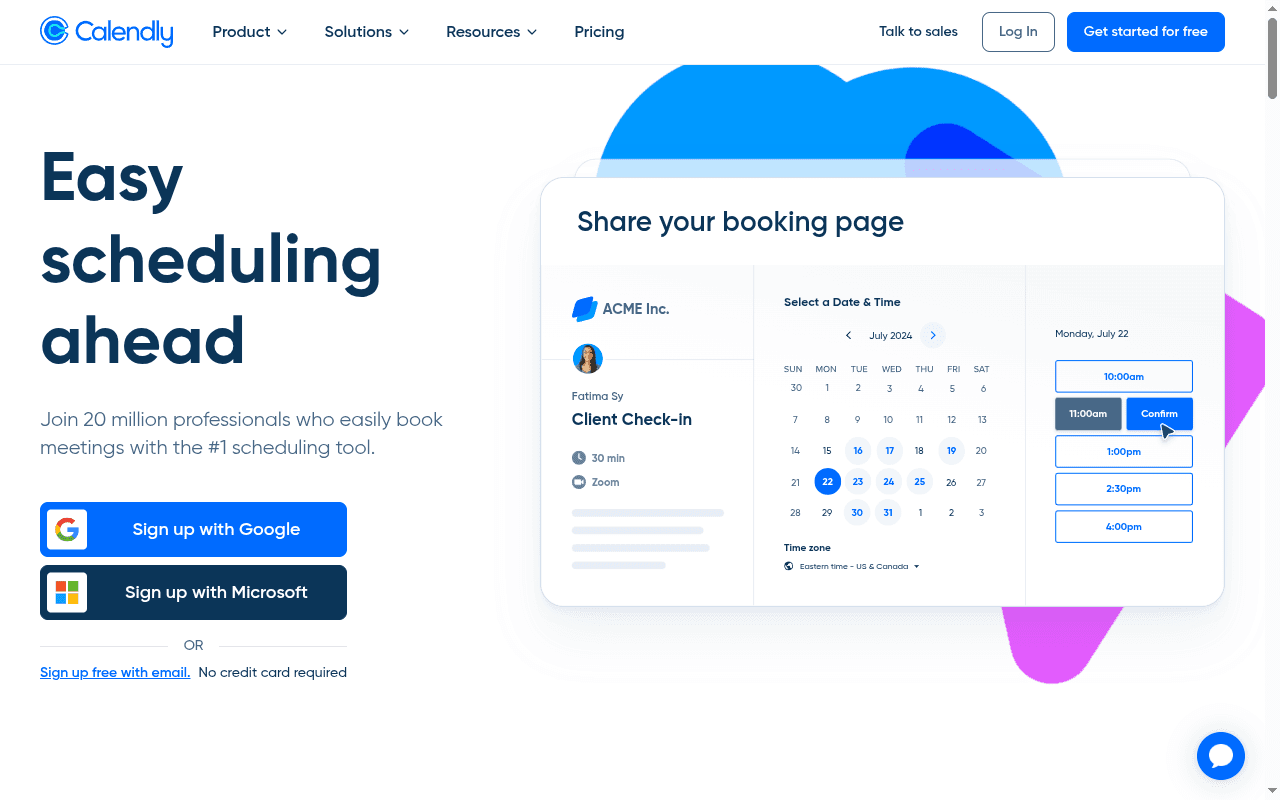
CL-3 does not fully pass (WHO is unclear), but WHAT is clear, so CL-4 is evaluated on the headline alone: 'Easy scheduling ahead' is a generic, pun-style tagline with no concrete outcome, number, or differentiation. It could apply to any calendar or scheduling product and contains no mechanism or measurable benefit.
Replace the headline with a specific, outcome-driven statement. Example: 'Book more meetings, waste less time — the #1 scheduling tool used by 20M professionals.' Lead with the quantified social proof or a concrete time-saving claim rather than a wordplay tagline.
Ogilvy, 'Ogilvy on Advertising' (1983) — 'The headline is the most important element. It should promise a benefit or deliver news.' Generic taglines that promise no specific benefit underperform headlines with concrete claims.
- 3 · CL-6 · mediumSingle message focus
The CTA cluster includes: 'Get started for free Get started' (primary signup), 'Payments Flexible ways to get paid' (payments feature), 'Developer docs Build with Calendly API' (developer product), and 'Sign up with Google' (OAuth signup). These represent at least 3 distinct destinations/goals — general signup, a payments feature, and a developer API — forcing a meta-decision on first-time visitors before they have understood the core product.
Consolidate the hero CTA to a single primary action: 'Sign up free.' Move 'Payments' and 'Developer docs' CTAs out of the hero/primary navigation cluster and into a secondary navigation bar or dedicated sections lower on the page. A visitor arriving at the homepage should face exactly one decision: sign up or learn more — not choose between three different product tracks.
Ogilvy, 'Confessions of an Advertising Man' (1963) — 'A advertisement is not a Christmas tree. You cannot hang every product on it.' Multiple competing CTAs dilute the primary conversion goal.
All findings
7 findings shown · 7 of 16 checks passing
Authority signals verifiable
Press/authority claim detected (Trusted by) but the logos/text are not linked to verifiable sources.
Wrap each press logo or 'Featured in' badge in an <a href> pointing to the actual article or brand page. Unlinked authority claims invite scepticism — the reader cannot verify them.
Headline specificity
CL-3 does not fully pass (WHO is unclear), but WHAT is clear, so CL-4 is evaluated on the headline alone: 'Easy scheduling ahead' is a generic, pun-style tagline with no concrete outcome, number, or differentiation. It could apply to any calendar or scheduling product and contains no mechanism or measurable benefit.
Replace the headline with a specific, outcome-driven statement. Example: 'Book more meetings, waste less time — the #1 scheduling tool used by 20M professionals.' Lead with the quantified social proof or a concrete time-saving claim rather than a wordplay tagline.
Single message focus
The CTA cluster includes: 'Get started for free Get started' (primary signup), 'Payments Flexible ways to get paid' (payments feature), 'Developer docs Build with Calendly API' (developer product), and 'Sign up with Google' (OAuth signup). These represent at least 3 distinct destinations/goals — general signup, a payments feature, and a developer API — forcing a meta-decision on first-time visitors before they have understood the core product.
Consolidate the hero CTA to a single primary action: 'Sign up free.' Move 'Payments' and 'Developer docs' CTAs out of the hero/primary navigation cluster and into a secondary navigation bar or dedicated sections lower on the page. A visitor arriving at the homepage should face exactly one decision: sign up or learn more — not choose between three different product tracks.
No named individuals with roles or photos confirmed on page
The body text references UI placeholder names ('Fatima Sy', 'Miguel Padilla', 'Jim Nobl') in product screenshot contexts (e.g., 'ACME Inc. Fatima Sy Client Check-in', 'Route to: Enterprise sales team Round robin for distribution Miguel Padilla Jim Nobl'), but these appear to be fictional demo personas within product illustrations, not real customers or team members with affiliations. No 'Meet the team' section, founder attribution, or named customer testimonials with company affiliations appear in the body or digest.
Add a founder or team section with real names, titles, and authentic headshots. Alternatively, include named customer testimonials with headshots and company affiliations. Even one clearly real, named individual with a verifiable role significantly increases perceived trustworthiness.
Legal trust links
Privacy Policy found, but no Terms of Service link
Add Terms of Service link (baseline trust signal).
Hero 5-second test
'Easy scheduling ahead' + 'Join 20 million professionals who easily book meetings with the #1 scheduling tool.' — WHAT (scheduling/booking meetings) is clear within 5 seconds. WHO is vague: '20 million professionals' is too broad to signal a specific audience (freelancers? enterprise teams? recruiters?), and the subhead does not narrow the use case.
Add a one-line qualifier in the hero that names the primary audience segment or use case — e.g., 'for teams, freelancers, and anyone who books meetings for a living' — so a first-time visitor self-identifies immediately. Alternatively, use a subhead that names a concrete role: 'The scheduling tool built for sales teams, recruiters, and consultants.'
Jargon and insider terminology
Body copy references 'buffers,' 'scheduling rules,' 'embed your availability,' and 'Calendly API' (in the CTA 'Developer docs Build with Calendly API') without plain-language glosses. However, none of these appear in the hero itself, and most are self-explanatory in context for the broad professional audience. The API/developer CTA does introduce a secondary technical audience without bridging language, creating mild audience tension.
The 'Developer docs Build with Calendly API' CTA in the primary nav/hero CTA cluster signals a developer audience but uses no plain-language bridge for non-technical visitors who may be confused about whether this product requires technical setup. Either move developer-facing CTAs to a footer or secondary nav, or add a brief qualifier such as 'No coding required for individuals and teams' near the hero to reassure non-technical visitors.
Independent automated analysis by PageLint. Not affiliated with or endorsed by Calendly. Findings reflect the public landing page as fetched on July 14, 2026 and may not match the current version.
How this was scored: 16 Clarity and Trust checks, each tied to a cited source (see all checks). No brand paid to be here. Calendly can request a re-audit at [email protected]. The Full Report ($29 one-time) runs all 55 checks. The free landing page checker runs the same 16 checks on any public URL.
See how your page scores on the same 16 checks
Paste your URL and get a score out of 100, with each finding quoted from your page and the source behind the rule. About 60 seconds, free, no signup.
More communication teardowns
- Intercom landing page teardown · 85/100
- Loom landing page teardown · 82/100
- Slack landing page teardown · 76/100
Related research
- Testimonials that convert: named, specific, outcome-first · 7 min read
- Social proof without 'as seen in' logos · 7 min read
- CTA copy that works: action verb + outcome, not 'Submit' · 6 min read