ClickUp landing page teardown: what to change
ClickUp scores 77/100 on PageLint's quick copy audit — a solid result with clear room to tighten. Trust is the stronger lens at 83/100, while Clarity trails at 71/100. The biggest issue the engine flagged: “Single dominant H1” (CL-1, medium severity).
What to change
- 1 · CL-1 · mediumSingle dominant H1
Found 2 H1 tags: ['Software to replace all software', 'AI that actually showed up to work. Across every team, every app, and every workflow.']
Use only one H1 per page. Demote secondary H1s to H2.
Ogilvy, Confessions of an Advertising Man, Ch. VI
- 2 · TR-4 · mediumAuthority signals verifiable
Press/authority claim detected (Trusted by) but the logos/text are not linked to verifiable sources.
Wrap each press logo or 'Featured in' badge in an <a href> pointing to the actual article or brand page. Unlinked authority claims invite scepticism — the reader cannot verify them.
Cialdini, Influence, Ch. 5 (Authority); Ogilvy
- 3 · CL-4 · mediumHeadline specificity
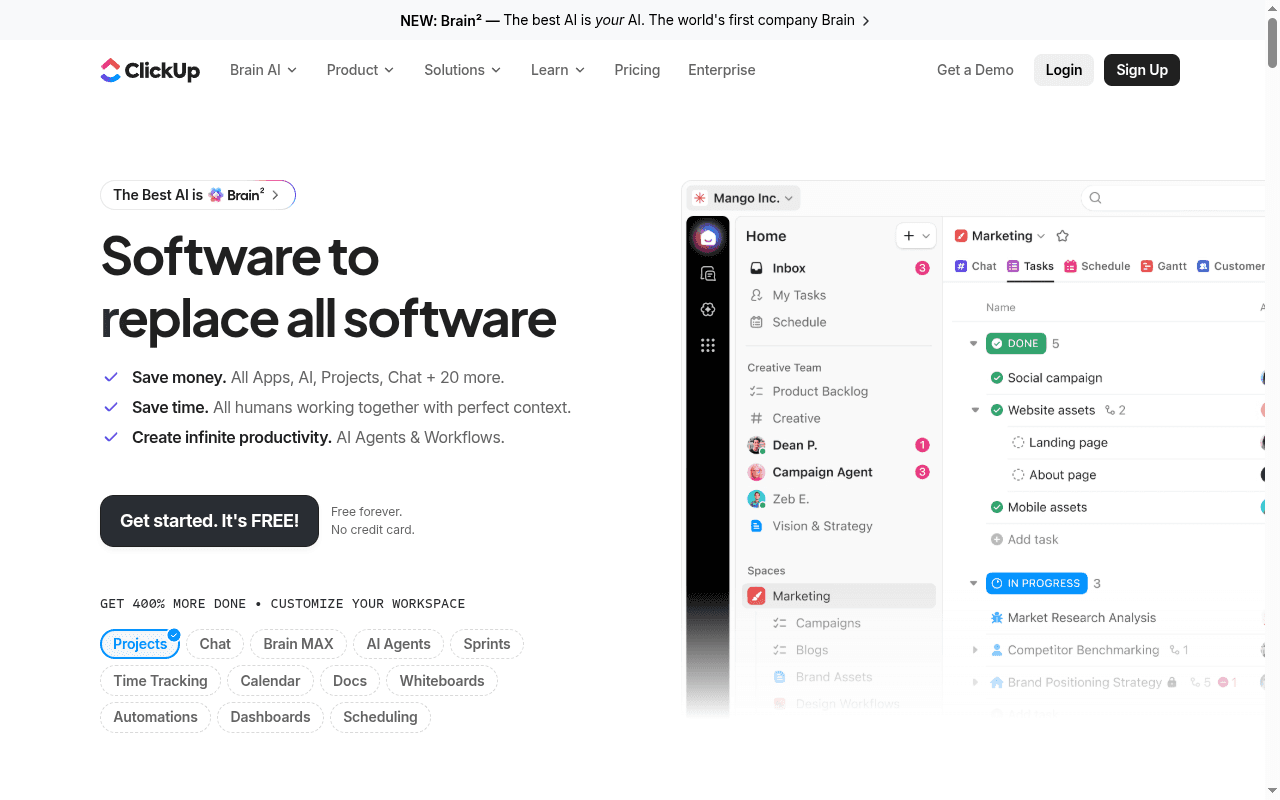
CL-3 returned 'low' (not a full fail), so CL-4 applies. The headline 'Software to replace all software' is a generic, self-referential claim with no concrete outcome, no number, and no differentiation mechanism. It could describe any broad SaaS suite — ERP, CRM, or an OS. The supporting line 'Save money. All Apps, AI, Projects, Chat + 20 more.' adds breadth but not specificity.
Replace or supplement the headline with a specific, measurable outcome. For example: 'One workspace for projects, docs, chat, and AI — teams report saving 3+ hours a day.' Anchor the claim with a real number or a named mechanism (e.g., 'AI Agents that automate your busywork') so the headline earns its boldness.
Ogilvy, 'Confessions of an Advertising Man' (1963): 'The headline is the most important element in most advertisements. It is the telegram which decides the reader whether to read the copy.' A vague telegram gets ignored.
All findings
7 findings shown · 8 of 16 checks passing
Single dominant H1
Found 2 H1 tags: ['Software to replace all software', 'AI that actually showed up to work. Across every team, every app, and every workflow.']
Use only one H1 per page. Demote secondary H1s to H2.
Authority signals verifiable
Press/authority claim detected (Trusted by) but the logos/text are not linked to verifiable sources.
Wrap each press logo or 'Featured in' badge in an <a href> pointing to the actual article or brand page. Unlinked authority claims invite scepticism — the reader cannot verify them.
Headline specificity
CL-3 returned 'low' (not a full fail), so CL-4 applies. The headline 'Software to replace all software' is a generic, self-referential claim with no concrete outcome, no number, and no differentiation mechanism. It could describe any broad SaaS suite — ERP, CRM, or an OS. The supporting line 'Save money. All Apps, AI, Projects, Chat + 20 more.' adds breadth but not specificity.
Replace or supplement the headline with a specific, measurable outcome. For example: 'One workspace for projects, docs, chat, and AI — teams report saving 3+ hours a day.' Anchor the claim with a real number or a named mechanism (e.g., 'AI Agents that automate your busywork') so the headline earns its boldness.
Jargon and insider terminology
'AI Agents & Workflows,' 'Brain MAX,' 'Super Agents,' 'Work Sprawl,' 'context,' 'Sprints,' 'Kanban Boards,' 'Gantt Charts,' 'Portfolios,' 'Single Sign-on,' 'API Calls' — multiple unexplained technical and product-branded terms cluster together in the hero and throughout the body. 'Brain MAX' and 'Super Agents' are proprietary brand names with no plain-language gloss. 'Work Sprawl' is coined jargon used as if self-evident. The page appears to target both technical users (developers, PMs) and non-technical business owners, yet uses PM/dev vocabulary exclusively.
Add a one-sentence plain-language explanation immediately after each proprietary term in the hero — e.g., 'Brain MAX (ClickUp's AI assistant)' or 'AI Agents — bots that complete tasks automatically so your team doesn't have to.' Remove or gloss 'Work Sprawl' with a parenthetical. Audit the feature list for terms (Gantt Charts, Sprints, SSO) that non-technical buyers will not recognize and add tooltips or brief descriptors.
No named individuals with roles or photos identifiable from content
The social proof digest contains three fully anonymous quotes with no speaker names, titles, or company affiliations. Image alt texts include labels such as 'Agent Orange', 'Work sprawl placeholder', 'Projects preview', and feature names — none indicate a named person's headshot or a 'Meet the team' section. No founder name, team member name, or named customer with a company affiliation appears anywhere in the body text or digest.
Add at least one named human face with a verifiable role: a founder bio with name and title, a 'Meet the team' section, or customer testimonials with full name, title, and company. Named attribution dramatically increases perceived authenticity and liking per Cialdini's familiarity principle.
Hero 5-second test
'Software to replace all software' — WHAT is broadly clear (an all-in-one software platform), but WHO it is for is never stated in the hero. There is no mention of team size, industry, role, or use case. The tagline is universal to the point of being audience-less.
Add a WHO qualifier to the hero — e.g., 'Software to replace all software — for teams who are done paying for 10 separate tools.' Even a single descriptor like 'for growing teams' or 'for businesses' anchors the audience and reduces bounce from unqualified visitors.
Single message focus
'Get a Demo, Sign Up, Get started. It's FREE, Get started. It's FREE!, Get started. It's FREE!' — there are two distinct CTA types: 'Get a Demo' (sales-led, high-intent) and 'Get started. It's FREE' (self-serve, low-friction). Both point toward the same product but represent meaningfully different conversion paths and buyer intents.
Establish a clear primary CTA hierarchy. If self-serve is the primary growth motion, make 'Get started free' the dominant button and demote 'Get a Demo' to a secondary text link below it. If enterprise/demo is the priority, reverse the hierarchy. Avoid presenting them as visual equals, which forces visitors to make a meta-decision about their own buyer journey.
Independent automated analysis by PageLint. Not affiliated with or endorsed by ClickUp. Findings reflect the public landing page as fetched on July 17, 2026 and may not match the current version.
How this was scored: 16 Clarity and Trust checks, each tied to a cited source (see all checks). No brand paid to be here. ClickUp can request a re-audit at [email protected]. The Full Report ($29 one-time) runs all 55 checks. The free landing page checker runs the same 16 checks on any public URL.
See how your page scores on the same 16 checks
Paste your URL and get a score out of 100, with each finding quoted from your page and the source behind the rule. About 60 seconds, free, no signup.
Compare ClickUp
- Basecamp vs ClickUp: landing page copy compared · 77 vs 85 for Basecamp
- Airtable vs ClickUp: landing page copy compared · 77 vs 68 for Airtable
- Coda vs ClickUp: landing page copy compared · 77 vs 74 for Coda
More project management teardowns
- Trello landing page teardown · 90/100
- Basecamp landing page teardown · 85/100
- Monday landing page teardown · 80/100