Dropbox landing page teardown: what to change
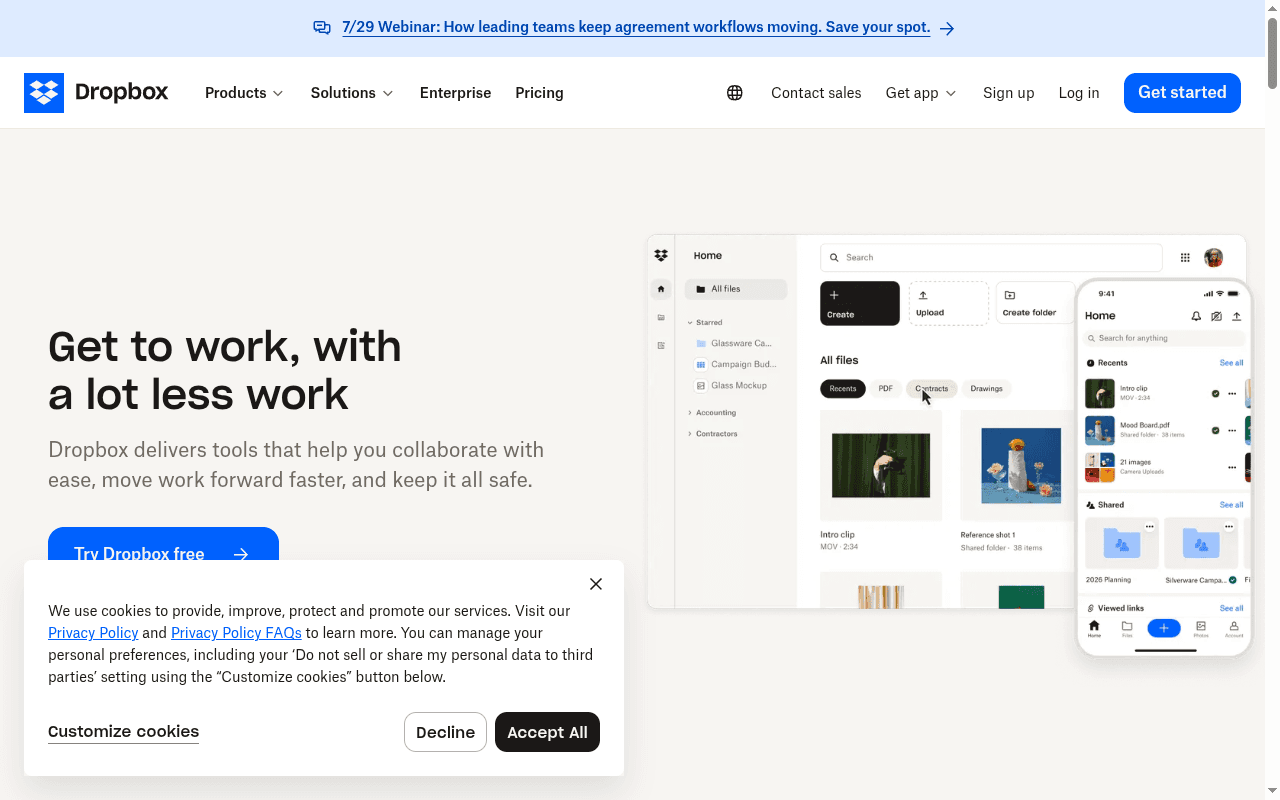
Dropbox scores 79/100 on PageLint's quick copy audit — a solid result with clear room to tighten. Trust is the stronger lens at 81/100, while Clarity trails at 77/100. The biggest issue the engine flagged: “Single message focus” (CL-6, high severity).
What to change
- 1 · CL-6 · highSingle message focus
CTAs present: 'Sign Request and add signatures to documents' (appears twice), 'Get app', 'Sign up', 'Get started', plus at least four instances of 'Try Dropbox free' and two 'Learn more' links within the first 2000 characters. The visitor faces a meta-decision: is this page about file storage, e-signatures, a mobile app download, or a free trial? 'Sign Request and add signatures to documents' promotes a distinct sub-product that competes with the core storage/sharing value proposition.
Establish one dominant CTA ('Try Dropbox free') and demote or remove 'Sign Request and add signatures to documents' from the hero CTA set — it belongs on a dedicated Sign product page. Consolidate 'Sign up' and 'Get started' into a single label. Limit the hero to one primary CTA and one low-commitment secondary link (e.g., 'See what's new'). Every additional CTA beyond two measurably reduces click-through on the primary action.
Ogilvy, 'Confessions of an Advertising Man' (1963): 'You cannot bore people into buying your product; you can only interest them in buying it.' Fragmented CTAs bore and confuse rather than interest. CXL Institute research on CTA hierarchy confirms that pages with a single dominant CTA outperform multi-CTA pages by 20–30% on primary conversion rate.
- 2 · TR-6 · highNo objection-handlers present near any CTA
CTAs present: 'Try Dropbox free', 'Sign up', 'Get started', 'Get app'. No instances of 'no credit card required', 'cancel anytime', 'money-back guarantee', '14-day free trial', 'SOC 2', 'GDPR', 'free plan', or 'no setup fee' found anywhere in the page content or social proof digest.
Add at least 2 objection-handling micro-copy elements directly beneath or adjacent to the primary 'Try Dropbox free' CTA — for example: 'No credit card required' and 'Cancel anytime'. Also consider adding a trust badge referencing SOC 2 or GDPR compliance near the security-focused CTA to reduce anxiety for business buyers.
CXL Institute anxiety lens research; Cialdini, R. (2001). Influence: The Psychology of Persuasion — reducing perceived risk at the point of decision lowers friction and increases conversion.
- 3 · CL-5 · mediumJargon and insider terminology
CAD, BIM, PDF, and visual content files — appearing in the industry section without plain-language explanation of CAD or BIM. Additionally, 'tamper-proof documents,' 'version history,' 'real-time syncing,' and 'large file transfers' cluster together in body copy without glossing. The page also targets a dual audience (construction professionals AND general teams) but uses construction-specific acronyms (CAD, BIM) with no parenthetical explanation for non-construction readers.
Expand CAD and BIM on first use (e.g., 'CAD and BIM (design and building model files)'). Audit the security section to ensure terms like 'tamper-proof documents' and 'version history' are each followed by a one-clause plain-language explanation. Because the page explicitly targets multiple industries, vocabulary must be accessible across all of them, not just construction or tech-savvy users.
CXL Institute, 'Landing Page Optimization' course: clarity of copy is the single highest-leverage conversion variable; unexplained jargon creates cognitive friction that disproportionately hurts conversion among secondary audiences.
All findings
6 findings shown · 10 of 16 checks passing
Single message focus
CTAs present: 'Sign Request and add signatures to documents' (appears twice), 'Get app', 'Sign up', 'Get started', plus at least four instances of 'Try Dropbox free' and two 'Learn more' links within the first 2000 characters. The visitor faces a meta-decision: is this page about file storage, e-signatures, a mobile app download, or a free trial? 'Sign Request and add signatures to documents' promotes a distinct sub-product that competes with the core storage/sharing value proposition.
Establish one dominant CTA ('Try Dropbox free') and demote or remove 'Sign Request and add signatures to documents' from the hero CTA set — it belongs on a dedicated Sign product page. Consolidate 'Sign up' and 'Get started' into a single label. Limit the hero to one primary CTA and one low-commitment secondary link (e.g., 'See what's new'). Every additional CTA beyond two measurably reduces click-through on the primary action.
No objection-handlers present near any CTA
CTAs present: 'Try Dropbox free', 'Sign up', 'Get started', 'Get app'. No instances of 'no credit card required', 'cancel anytime', 'money-back guarantee', '14-day free trial', 'SOC 2', 'GDPR', 'free plan', or 'no setup fee' found anywhere in the page content or social proof digest.
Add at least 2 objection-handling micro-copy elements directly beneath or adjacent to the primary 'Try Dropbox free' CTA — for example: 'No credit card required' and 'Cancel anytime'. Also consider adding a trust badge referencing SOC 2 or GDPR compliance near the security-focused CTA to reduce anxiety for business buyers.
Jargon and insider terminology
CAD, BIM, PDF, and visual content files — appearing in the industry section without plain-language explanation of CAD or BIM. Additionally, 'tamper-proof documents,' 'version history,' 'real-time syncing,' and 'large file transfers' cluster together in body copy without glossing. The page also targets a dual audience (construction professionals AND general teams) but uses construction-specific acronyms (CAD, BIM) with no parenthetical explanation for non-construction readers.
Expand CAD and BIM on first use (e.g., 'CAD and BIM (design and building model files)'). Audit the security section to ensure terms like 'tamper-proof documents' and 'version history' are each followed by a one-clause plain-language explanation. Because the page explicitly targets multiple industries, vocabulary must be accessible across all of them, not just construction or tech-savvy users.
Hero 5-second test
Find, organize, and share your work, all in one place
WHAT (file storage and sharing) is reasonably clear, but WHO is undefined — the hero could target freelancers, enterprises, students, or anyone. Add a one-line qualifier in the hero that anchors the audience, e.g., 'for teams and individuals who need one home for all their files.' A subheadline is entirely absent, which is a missed opportunity to specify the target user and primary differentiator.
Testimonials lack ICP role/company specificity
Testimonial: 'The security of knowing our information is safe.' — Customer Bryan Chandler reveals how his team uses Dropbox to organize and share files securely. Testimonial: 'Seriously impressive security features' — Tech influencer Justin Tse discusses why he trusts Dropbox to keep his content safe.
Replace or supplement the 'tech influencer' testimonial with testimonials from named individuals who explicitly state their role, company size, and industry (e.g., 'Head of IT at a 200-person media agency'). Bryan Chandler's testimonial should include his job title and company type to signal ICP match. Add 2+ testimonials from the industries listed (Construction, Media, Technology, Professional Services) with explicit role and company context.
Limited named human presence; no team or founder attribution visible
Named individuals in content: 'Customer Bryan Chandler' (no role or company stated) and 'Tech influencer Justin Tse' (no company affiliation). Social proof digest image alt texts reference logos (McLaren, Crunch, Cirque du Soleil, Wag!, Hydro Flask, etc.) and 'Two women in fashionab[le clothing]' — suggesting possible stock imagery rather than named individuals with roles.
Add a founder or leadership section with named individuals, titles, and authentic headshots. Ensure testimonial entries include a name, job title, company, and ideally a headshot with descriptive alt text (e.g., 'Photo of Bryan Chandler, IT Manager at Acme Corp') to signal authenticity and build liking through familiarity.
Independent automated analysis by PageLint. Not affiliated with or endorsed by Dropbox. Findings reflect the public landing page as fetched on July 16, 2026 and may not match the current version.
How this was scored: 16 Clarity and Trust checks, each tied to a cited source (see all checks). No brand paid to be here. Dropbox can request a re-audit at [email protected]. The Full Report ($29 one-time) runs all 55 checks. The free landing page checker runs the same 16 checks on any public URL.
See how your page scores on the same 16 checks
Paste your URL and get a score out of 100, with each finding quoted from your page and the source behind the rule. About 60 seconds, free, no signup.
Related research
- The Clarity lens: 8 checks for landing pages that convert · 14 min read
- Schwartz awareness states explained · 18 min read
- Most-aware headlines: write the offer, not the pitch · 5 min read