Framer landing page teardown: what to change
Framer scores 68/100 on PageLint's quick copy audit — a mixed result — strong in places, leaky in others. Clarity is the stronger lens at 83/100, while Trust trails at 52/100. The biggest issue the engine flagged: “Testimonials lack ICP-matched social proof” (TR-2, high severity).
What to change
- 1 · TR-2 · highTestimonials lack ICP-matched social proof
The Social Proof Digest shows image alt texts referencing 'Maggie Site', 'Midlife Engineering', 'i-D Elle Fanning Site', and 'Website showcase preview made in Framer' — these are site showcases, not testimonials with named individuals, roles, company types, or industries. The body text contains 'Meet our customers' and 'Read story' links but no actual testimonial quotes, roles, or company affiliations are present in the extractable content.
Add 2+ testimonials that explicitly state the reviewer's role (e.g., 'Head of Marketing'), company type (e.g., 'Series B SaaS startup'), and a specific outcome (e.g., 'We launched our rebrand in 3 days instead of 3 weeks'). Ensure these match Framer's ICP — likely designers, marketing teams, or founders at growth-stage companies — so visitors self-identify with the social proof.
Cialdini, R. (2001). Influence: The Psychology of Persuasion. Ch. 4 — Social proof is most powerful when the person observing it perceives similarity to themselves (the 'similarity amplifier').
- 2 · TR-6 · highNo objection-handling signals near any CTA
CTAs present: 'Sign up', 'Get started for free', 'Start with agents', 'Get started for free'. No objection-handling signals found anywhere in the extractable page content — no 'no credit card required', 'cancel anytime', 'money-back guarantee', 'free trial', 'SOC 2', 'GDPR', 'free plan', or 'no setup fee' language appears in the body text or section headings.
Place at least 2 objection-handlers directly beneath or adjacent to the primary CTA. For example, add 'No credit card required · Cancel anytime' as microcopy under 'Get started for free'. If Framer has a free plan, state it explicitly near the CTA (e.g., 'Free plan available — no credit card needed'). Security signals like SOC 2 or GDPR compliance near the CTA would further reduce anxiety for enterprise visitors.
CXL Institute anxiety lens research; Cialdini, R. (2001). Influence: The Psychology of Persuasion — reducing perceived risk at the moment of decision lowers friction and increases conversion.
- 3 · TR-1 · mediumLegal trust links
No Privacy Policy or Terms link found
Add Privacy Policy and Terms links to footer. Both are baseline trust signals.
GDPR/CCPA compliance; Baymard Institute trust research
All findings
7 findings shown · 7 of 16 checks passing
Testimonials lack ICP-matched social proof
The Social Proof Digest shows image alt texts referencing 'Maggie Site', 'Midlife Engineering', 'i-D Elle Fanning Site', and 'Website showcase preview made in Framer' — these are site showcases, not testimonials with named individuals, roles, company types, or industries. The body text contains 'Meet our customers' and 'Read story' links but no actual testimonial quotes, roles, or company affiliations are present in the extractable content.
Add 2+ testimonials that explicitly state the reviewer's role (e.g., 'Head of Marketing'), company type (e.g., 'Series B SaaS startup'), and a specific outcome (e.g., 'We launched our rebrand in 3 days instead of 3 weeks'). Ensure these match Framer's ICP — likely designers, marketing teams, or founders at growth-stage companies — so visitors self-identify with the social proof.
No objection-handling signals near any CTA
CTAs present: 'Sign up', 'Get started for free', 'Start with agents', 'Get started for free'. No objection-handling signals found anywhere in the extractable page content — no 'no credit card required', 'cancel anytime', 'money-back guarantee', 'free trial', 'SOC 2', 'GDPR', 'free plan', or 'no setup fee' language appears in the body text or section headings.
Place at least 2 objection-handlers directly beneath or adjacent to the primary CTA. For example, add 'No credit card required · Cancel anytime' as microcopy under 'Get started for free'. If Framer has a free plan, state it explicitly near the CTA (e.g., 'Free plan available — no credit card needed'). Security signals like SOC 2 or GDPR compliance near the CTA would further reduce anxiety for enterprise visitors.
Legal trust links
No Privacy Policy or Terms link found
Add Privacy Policy and Terms links to footer. Both are baseline trust signals.
Authority signals verifiable
Press/authority claim detected (Trusted by) but the logos/text are not linked to verifiable sources.
Wrap each press logo or 'Featured in' badge in an <a href> pointing to the actual article or brand page. Unlinked authority claims invite scepticism — the reader cannot verify them.
Jargon and insider terminology
Multiple unexplained technical terms cluster in the body without plain-language glosses: 'native to the canvas,' 'CMS agent,' 'connecting it directly to the canvas,' 'Codex,' 'Claude Code,' 'Cursor,' 'GitHub PR,' 'Terminal,' 'Locales.' The page also explicitly targets a dual audience — design-oriented users ('canvas,' 'design agent') AND developer-oriented users ('GitHub PR,' 'Codex,' 'Cursor,' 'terminal') — but uses each audience's vocabulary interchangeably without bridging language. A non-technical marketing manager reading 'Ship from a GitHub PR. Drive it all from your Terminal, Codex, Claude Code, Cursor' cannot decode the value proposition without prior knowledge.
Segment jargon by audience section or add brief plain-language parentheticals. For example: 'Ship from a GitHub PR (your developer's code review workflow)' or create distinct sections labeled 'For designers' and 'For developers' so each audience's vocabulary is contextually appropriate. The hero and primary value prop must remain jargon-free for the broadest possible first impression.
No named individuals with roles or photos identifiable
The Social Proof Digest image alt texts include 'Maggie Site' and 'Midlife Engineering' but these appear to be site names or showcase labels, not named individuals with roles or company affiliations. No team section, founder attribution, or named customer testimonials with titles are present in the body text. No headshot alt text patterns (e.g., 'Photo of [Name], CEO at [Company]') are detectable.
Add a 'Meet the team' or founder section with real named individuals, their titles, and authentic photos. Supplement with named customer testimonials that include a headshot, full name, and role/company. This activates the familiarity and liking heuristic, increasing visitor trust through perceived human connection.
Hero 5-second test
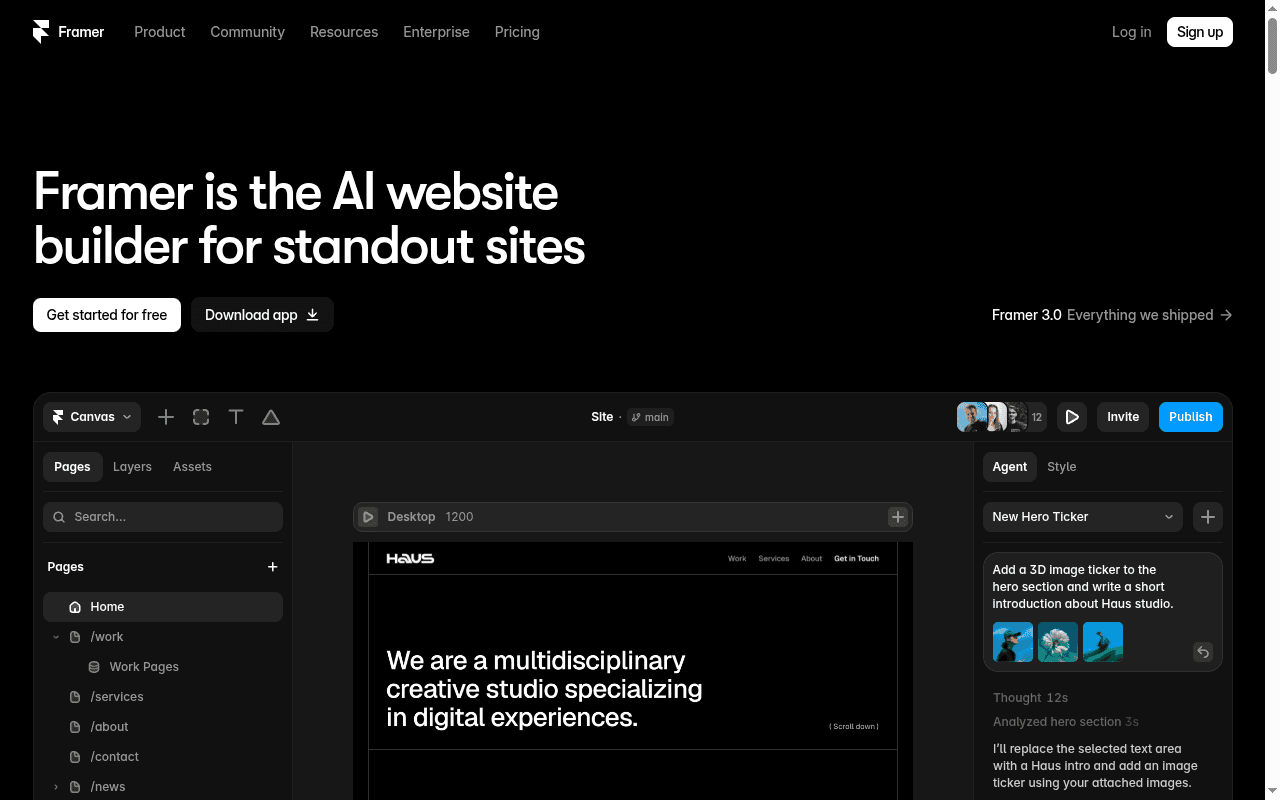
"Framer is the AI website builder for standout sites" — WHAT is clear (AI website builder), but WHO is unclear. 'Standout sites' is aspirational filler that doesn't identify a target audience (designers? marketers? developers? founders?). No subhead exists to rescue the WHO.
Add a subhead that names the target user explicitly, e.g., 'Built for designers and teams who want to ship fast without touching code' or 'For marketing teams and designers who need a professional site without a developer.' The hero must answer WHO within 5 seconds without requiring the visitor to scroll.
Independent automated analysis by PageLint. Not affiliated with or endorsed by Framer. Findings reflect the public landing page as fetched on July 14, 2026 and may not match the current version.
How this was scored: 16 Clarity and Trust checks, each tied to a cited source (see all checks). No brand paid to be here. Framer can request a re-audit at [email protected]. The Full Report ($29 one-time) runs all 55 checks. The free landing page checker runs the same 16 checks on any public URL.
See how your page scores on the same 16 checks
Paste your URL and get a score out of 100, with each finding quoted from your page and the source behind the rule. About 60 seconds, free, no signup.
Compare Framer
- Webflow vs Framer: landing page copy compared · 68 vs 66 for Webflow
More site builders teardowns
- Webflow landing page teardown · 66/100
Related research
- Social proof without 'as seen in' logos · 7 min read
- CTA copy that works: action verb + outcome, not 'Submit' · 6 min read
- The Trust lens: 8 checks for landing pages visitors believe · 12 min read