HubSpot landing page teardown: what to change
HubSpot scores 80/100 on PageLint's quick copy audit — a solid result with clear room to tighten. Trust is the stronger lens at 86/100, while Clarity trails at 74/100. The biggest issue the engine flagged: “Headline specificity” (CL-4, medium severity).
What to change
- 1 · CL-4 · mediumHeadline specificity
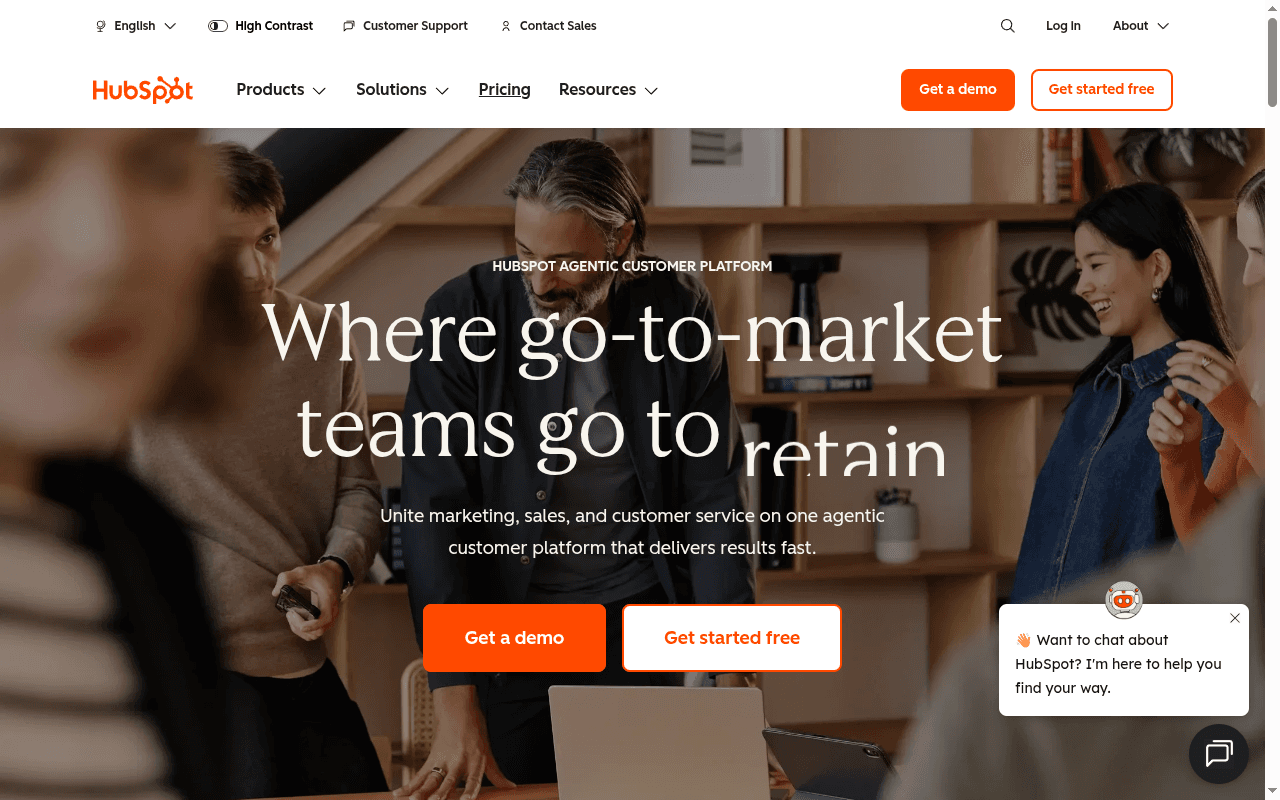
CL-3 did not fully pass (severity: low), but WHO ambiguity was the primary issue rather than WHAT, so CL-4 is evaluated. The H1 'Where go-to-market teams go to grow scale close retain grow' is entirely generic — 'grow,' 'scale,' 'close,' and 'retain' are rotating buzzwords with no concrete outcome, number, timeframe, or differentiation. The subhead adds 'delivers results fast' which is equally vague. No specific metric, mechanism, or differentiator appears in the hero.
Anchor the headline to a specific, verifiable outcome or differentiator. For example, reference the '299,000+ customers in over 135 countries' stat (which appears below the fold) or a concrete time-to-value claim. Ogilvy's principle: specificity sells. 'Grow pipeline 2x faster with one connected platform' outperforms 'grow scale close retain' every time.
Ogilvy, 'Confessions of an Advertising Man' (1963): 'The more informative your advertising, the more persuasive it will be.' CXL Institute headline research confirms specific outcomes consistently outperform generic benefit statements in A/B tests.
- 2 · CL-5 · mediumJargon and insider terminology
'Agentic customer platform' appears twice in the hero area — in the navigation label 'HubSpot Agentic Customer Platform' and in the subhead 'one agentic customer platform.' 'Agentic' is an emerging AI-industry term with no plain-language gloss anywhere in the first 2000 characters. Additionally, 'go-to-market teams,' 'Smart CRM,' and 'Breeze: AI that gets your work done' cluster together without explanation. A journalist or small business owner cannot decode 'agentic' without a lookup. The page does not explicitly target a secondary non-technical audience, but HubSpot's known customer base includes non-technical SMB owners.
Either remove 'agentic' from the hero entirely and reintroduce it lower on the page with a plain-language explanation (e.g., 'agentic — meaning AI that acts on your behalf'), or replace it in the hero with a benefit-led phrase such as 'AI-powered platform that works for you.' Never use emerging technical vocabulary in the hero without an immediate gloss.
CXL Institute, conversion copywriting research: clarity of value proposition is the single highest-leverage variable on landing pages; unexplained jargon in the hero measurably increases bounce rate. Ogilvy, 'Ogilvy on Advertising' (1983): 'Never use jargon words like reconceptualize... they are hallmarks of a pretentious ass.'
- 3 · CL-6 · mediumSingle message focus
Five distinct CTAs appear in the hero/above-fold area: 'Build pipeline,' 'Create content,' 'Grow sales and get paid,' 'Build pipeline' (repeated), 'Create content' (repeated), plus two primary CTAs 'Get a demo of HubSpot's premium software' and 'Get started free with HubSpot's free tools.' The visitor faces at least 3 distinct action paths (demo, free signup, and product-specific task CTAs) that lead to different destinations and represent different commitment levels. This creates a meta-decision problem.
Consolidate the hero to a maximum of two CTAs that serve the same conversion goal at different commitment levels (e.g., 'Get a demo' as primary, 'Start free' as secondary). Remove the 'Build pipeline / Create content / Grow sales' task-based CTAs from the hero — they belong on a product page or below the fold after the visitor has self-selected. One hero, one decision.
CXL Institute, 'Landing Page Optimization' research: pages with a single, focused CTA consistently outperform multi-CTA pages; each additional CTA reduces conversion rate by fragmenting visitor intent. Schwartz, 'Breakthrough Advertising' (1966): the offer must be singular and unmistakable to move the prospect to action.
All findings
7 findings shown · 9 of 16 checks passing
Headline specificity
CL-3 did not fully pass (severity: low), but WHO ambiguity was the primary issue rather than WHAT, so CL-4 is evaluated. The H1 'Where go-to-market teams go to grow scale close retain grow' is entirely generic — 'grow,' 'scale,' 'close,' and 'retain' are rotating buzzwords with no concrete outcome, number, timeframe, or differentiation. The subhead adds 'delivers results fast' which is equally vague. No specific metric, mechanism, or differentiator appears in the hero.
Anchor the headline to a specific, verifiable outcome or differentiator. For example, reference the '299,000+ customers in over 135 countries' stat (which appears below the fold) or a concrete time-to-value claim. Ogilvy's principle: specificity sells. 'Grow pipeline 2x faster with one connected platform' outperforms 'grow scale close retain' every time.
Jargon and insider terminology
'Agentic customer platform' appears twice in the hero area — in the navigation label 'HubSpot Agentic Customer Platform' and in the subhead 'one agentic customer platform.' 'Agentic' is an emerging AI-industry term with no plain-language gloss anywhere in the first 2000 characters. Additionally, 'go-to-market teams,' 'Smart CRM,' and 'Breeze: AI that gets your work done' cluster together without explanation. A journalist or small business owner cannot decode 'agentic' without a lookup. The page does not explicitly target a secondary non-technical audience, but HubSpot's known customer base includes non-technical SMB owners.
Either remove 'agentic' from the hero entirely and reintroduce it lower on the page with a plain-language explanation (e.g., 'agentic — meaning AI that acts on your behalf'), or replace it in the hero with a benefit-led phrase such as 'AI-powered platform that works for you.' Never use emerging technical vocabulary in the hero without an immediate gloss.
Single message focus
Five distinct CTAs appear in the hero/above-fold area: 'Build pipeline,' 'Create content,' 'Grow sales and get paid,' 'Build pipeline' (repeated), 'Create content' (repeated), plus two primary CTAs 'Get a demo of HubSpot's premium software' and 'Get started free with HubSpot's free tools.' The visitor faces at least 3 distinct action paths (demo, free signup, and product-specific task CTAs) that lead to different destinations and represent different commitment levels. This creates a meta-decision problem.
Consolidate the hero to a maximum of two CTAs that serve the same conversion goal at different commitment levels (e.g., 'Get a demo' as primary, 'Start free' as secondary). Remove the 'Build pipeline / Create content / Grow sales' task-based CTAs from the hero — they belong on a product page or below the fold after the visitor has self-selected. One hero, one decision.
Objections Handled Near CTA
The primary CTAs are 'Get a demo of HubSpot's premium software' and 'Get started free with HubSpot's free tools'. The phrase 'Get started free' implies a free plan, which is one objection-handler. However, no explicit signals such as 'no credit card required', 'cancel anytime', 'money-back guarantee', '14-day free trial', 'SOC 2', 'GDPR', or 'no setup fee' appear in the extracted content near or adjacent to any CTA. Only one implicit objection-handler ('free' in CTA label) is detectable from the page content provided.
Add at least one additional explicit objection-handler directly beneath or adjacent to each primary CTA — for example, 'No credit card required' or 'Cancel anytime' — to reach the 2+ threshold. Consider also surfacing a trust badge (SOC 2, GDPR) near the demo CTA to address enterprise security concerns.
Legal trust links
Privacy Policy found, but no Terms of Service link
Add Terms of Service link (baseline trust signal).
Hero 5-second test
H1: 'Where go-to-market teams go to grow scale close retain grow' — WHAT is reasonably clear (a platform for marketing, sales, and customer service). WHO is vague: 'go-to-market teams' is an insider phrase that excludes non-technical founders, small business owners, or solopreneurs who may also be the intended audience. The subhead adds 'marketing, sales, and customer service' which helps, but the primary H1 does not anchor a specific audience type.
Replace 'go-to-market teams' in the H1 with a plain-language audience descriptor such as 'growing businesses' or 'marketing, sales, and service teams.' The WHO should be immediately legible to a first-time visitor without industry vocabulary. Example reframe: 'The platform where marketing, sales, and service teams grow faster — together.'
Real Human Faces Present
Three named individuals with titles and company affiliations appear in the social proof digest: Adam Jones (Director of Business Development, Unipart), Whitney Hallock (Director of Marketing & Experience, Angel City FC), and John Mothershead (Director of Member Success, Youth on Course). No team section, founder names with titles, or headshot alt text patterns are visible in the extracted content. Photo authenticity cannot be confirmed without visual analysis.
Add headshot alt text that includes the person's name (e.g., alt='Adam Jones, Director of Business Development at Unipart') to make photo attribution machine-readable and reinforce authenticity. Consider adding a founder or team section with named individuals and titles to further humanize the brand.
Independent automated analysis by PageLint. Not affiliated with or endorsed by HubSpot. Findings reflect the public landing page as fetched on July 17, 2026 and may not match the current version.
How this was scored: 16 Clarity and Trust checks, each tied to a cited source (see all checks). No brand paid to be here. HubSpot can request a re-audit at [email protected]. The Full Report ($29 one-time) runs all 55 checks. The free landing page checker runs the same 16 checks on any public URL.
See how your page scores on the same 16 checks
Paste your URL and get a score out of 100, with each finding quoted from your page and the source behind the rule. About 60 seconds, free, no signup.
More marketing and crm teardowns
- Mailchimp landing page teardown · 92/100