Intercom landing page teardown: what to change
Intercom scores 85/100 on PageLint's quick copy audit — one of the strongest pages we have run through the engine. Clarity is the stronger lens at 86/100, while Trust trails at 84/100. The biggest issue the engine flagged: “Objections handled near CTA” (TR-6, high severity).
What to change
- 1 · TR-6 · highObjections handled near CTA
CTAs present: 'Start free trial' (repeated 5 times), 'View demo'. No objection-handling signals found adjacent to or within the same section as any CTA. Signals searched for — 'no credit card required', 'cancel anytime', 'money-back guarantee', '14-day free trial', 'SOC 2', 'GDPR', 'free plan', 'no setup fee' — are absent from the provided page content and social proof digest.
Add at least 2 objection-handling micro-copy elements directly beneath or adjacent to the primary 'Start free trial' CTA. Recommended: 'No credit card required' and 'Cancel anytime' as a minimum. Consider also adding 'SOC 2 certified' or 'GDPR compliant' for enterprise buyers who have security objections before committing.
CXL Institute anxiety lens research; Cialdini, R. (2001). Influence: The Psychology of Persuasion — reducing perceived risk at the moment of decision lowers friction and increases conversion.
- 2 · CL-5 · mediumJargon and insider terminology
'AI Agent era', 'natively integrated AI Agent', 'omnichannel inbox', 'AI-powered ticketing', 'Copilot', 'Fin', 'Recommendations' (capitalized as a product feature), and 'data integrations' all appear without plain-language glosses. 'AI Agent era' appears in the H1 itself — a coined phrase that presupposes familiarity with a specific industry framing. 'Omnichannel inbox' and 'AI-powered ticketing' cluster together in a single paragraph with no explanation. The page also implicitly targets both technical buyers (who configure integrations) and business/CX leaders (who care about customer experience outcomes), yet the vocabulary skews toward the technical side throughout.
1) Replace or gloss 'AI Agent era' in the H1 with plain language — e.g., 'the era where AI handles customer conversations automatically.' 2) Add a one-sentence plain-English explanation the first time 'omnichannel inbox' and 'AI-powered ticketing' appear (e.g., 'one inbox for email, chat, and social — with tickets created and routed automatically'). 3) Rename or explain 'Copilot' on first use so non-technical CX leaders understand it is an in-app AI assistant for human agents. 4) If the page targets both technical and business audiences, consider a two-column value prop or audience-selector to serve each vocabulary set.
Schwartz, 'Breakthrough Advertising' (1966): copy must meet the prospect at their current level of awareness — jargon that exceeds that level breaks the connection before the argument begins.
- 3 · CL-3 · lowHero 5-second test
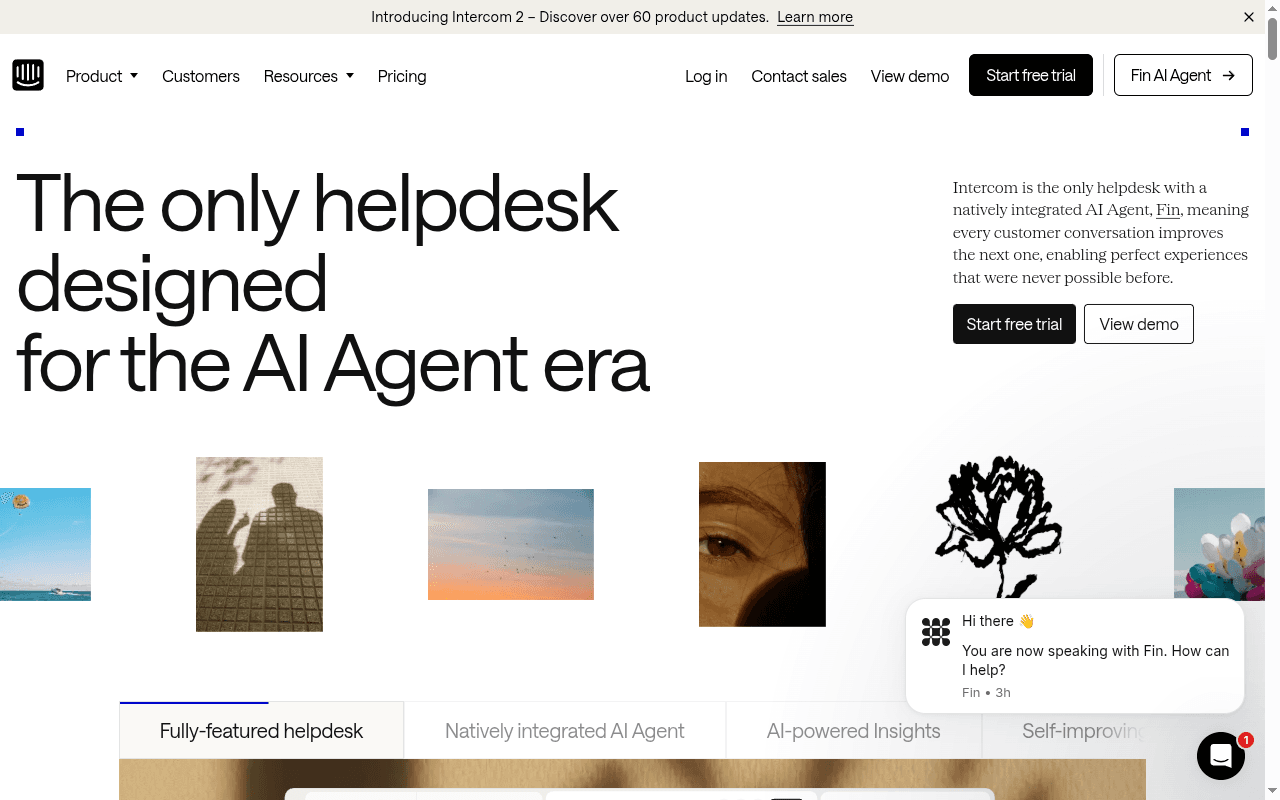
The only helpdesk designed for the AI Agent era — WHAT (a helpdesk) is clear within seconds. WHO is not stated: the hero never specifies customer support teams, SMBs, enterprises, or any audience segment. A first-time visitor must infer the target user from context.
Add a WHO qualifier to the H1 or introduce a subheadline that names the audience. For example: 'The only helpdesk for customer support teams — built for the AI Agent era.' Even a short subhead like 'Built for support teams who want AI to handle the work' would resolve the ambiguity without cluttering the headline.
Ogilvy, 'Ogilvy on Advertising' (1983): 'Tell the reader who you are talking to. If you are not talking to everybody, say so.'
All findings
5 findings shown · 11 of 16 checks passing
Objections handled near CTA
CTAs present: 'Start free trial' (repeated 5 times), 'View demo'. No objection-handling signals found adjacent to or within the same section as any CTA. Signals searched for — 'no credit card required', 'cancel anytime', 'money-back guarantee', '14-day free trial', 'SOC 2', 'GDPR', 'free plan', 'no setup fee' — are absent from the provided page content and social proof digest.
Add at least 2 objection-handling micro-copy elements directly beneath or adjacent to the primary 'Start free trial' CTA. Recommended: 'No credit card required' and 'Cancel anytime' as a minimum. Consider also adding 'SOC 2 certified' or 'GDPR compliant' for enterprise buyers who have security objections before committing.
Jargon and insider terminology
'AI Agent era', 'natively integrated AI Agent', 'omnichannel inbox', 'AI-powered ticketing', 'Copilot', 'Fin', 'Recommendations' (capitalized as a product feature), and 'data integrations' all appear without plain-language glosses. 'AI Agent era' appears in the H1 itself — a coined phrase that presupposes familiarity with a specific industry framing. 'Omnichannel inbox' and 'AI-powered ticketing' cluster together in a single paragraph with no explanation. The page also implicitly targets both technical buyers (who configure integrations) and business/CX leaders (who care about customer experience outcomes), yet the vocabulary skews toward the technical side throughout.
1) Replace or gloss 'AI Agent era' in the H1 with plain language — e.g., 'the era where AI handles customer conversations automatically.' 2) Add a one-sentence plain-English explanation the first time 'omnichannel inbox' and 'AI-powered ticketing' appear (e.g., 'one inbox for email, chat, and social — with tickets created and routed automatically'). 3) Rename or explain 'Copilot' on first use so non-technical CX leaders understand it is an in-app AI assistant for human agents. 4) If the page targets both technical and business audiences, consider a two-column value prop or audience-selector to serve each vocabulary set.
Hero 5-second test
The only helpdesk designed for the AI Agent era — WHAT (a helpdesk) is clear within seconds. WHO is not stated: the hero never specifies customer support teams, SMBs, enterprises, or any audience segment. A first-time visitor must infer the target user from context.
Add a WHO qualifier to the H1 or introduce a subheadline that names the audience. For example: 'The only helpdesk for customer support teams — built for the AI Agent era.' Even a short subhead like 'Built for support teams who want AI to handle the work' would resolve the ambiguity without cluttering the headline.
Single message focus
Five instances of 'Start free trial' appear as the primary CTA, all pointing to the same conversion goal. A secondary 'View demo' CTA appears at least twice. Both CTAs serve the same macro-goal (evaluate and adopt Intercom) and represent a classic trial-vs-demo pairing rather than competing offers.
The dual CTA pattern is acceptable but could be tightened. Consider making 'View demo' visually subordinate (ghost/outline button) to 'Start free trial' (filled/primary button) at every instance to establish a clear hierarchy and reduce micro-hesitation about which action to take first.
Real human faces present
Three named individuals with roles and company affiliations appear in testimonials: Isabel Larrow (Product Support Operations at Anthropic), Angelo Livanos (Senior Director of Global Support at Lightspeed), George Dilthey (Head of Support at Clay). However, image alt texts describe abstract or nature imagery ('Kite flying over the ocean', 'Silhouettes of two people cast in shadow', 'Sunset sky with birds in flight', 'Close-up portrait of a person's eye and face') with no alt text patterns indicating named headshots or team photos.
Add named headshot photos alongside each testimonial with descriptive alt text (e.g., 'Isabel Larrow, Product Support Operations at Anthropic') to reinforce authenticity. Consider adding a 'Meet the team' or founder section with real photos and names to further humanize the brand.
Independent automated analysis by PageLint. Not affiliated with or endorsed by Intercom. Findings reflect the public landing page as fetched on July 14, 2026 and may not match the current version.
How this was scored: 16 Clarity and Trust checks, each tied to a cited source (see all checks). No brand paid to be here. Intercom can request a re-audit at [email protected]. The Full Report ($29 one-time) runs all 55 checks. The free landing page checker runs the same 16 checks on any public URL.
See how your page scores on the same 16 checks
Paste your URL and get a score out of 100, with each finding quoted from your page and the source behind the rule. About 60 seconds, free, no signup.
More communication teardowns
- Loom landing page teardown · 82/100
- Calendly landing page teardown · 77/100
- Slack landing page teardown · 76/100