Monday landing page teardown: what to change
Monday scores 80/100 on PageLint's quick copy audit — a solid result with clear room to tighten. Trust is the stronger lens at 82/100, while Clarity trails at 79/100. The biggest issue the engine flagged: “Authority signals verifiable” (TR-4, medium severity).
What to change
- 1 · TR-4 · mediumAuthority signals verifiable
Press/authority claim detected (Trusted by) but the logos/text are not linked to verifiable sources.
Wrap each press logo or 'Featured in' badge in an <a href> pointing to the actual article or brand page. Unlinked authority claims invite scepticism — the reader cannot verify them.
Cialdini, Influence, Ch. 5 (Authority); Ogilvy
- 2 · CL-4 · mediumHeadline specificity
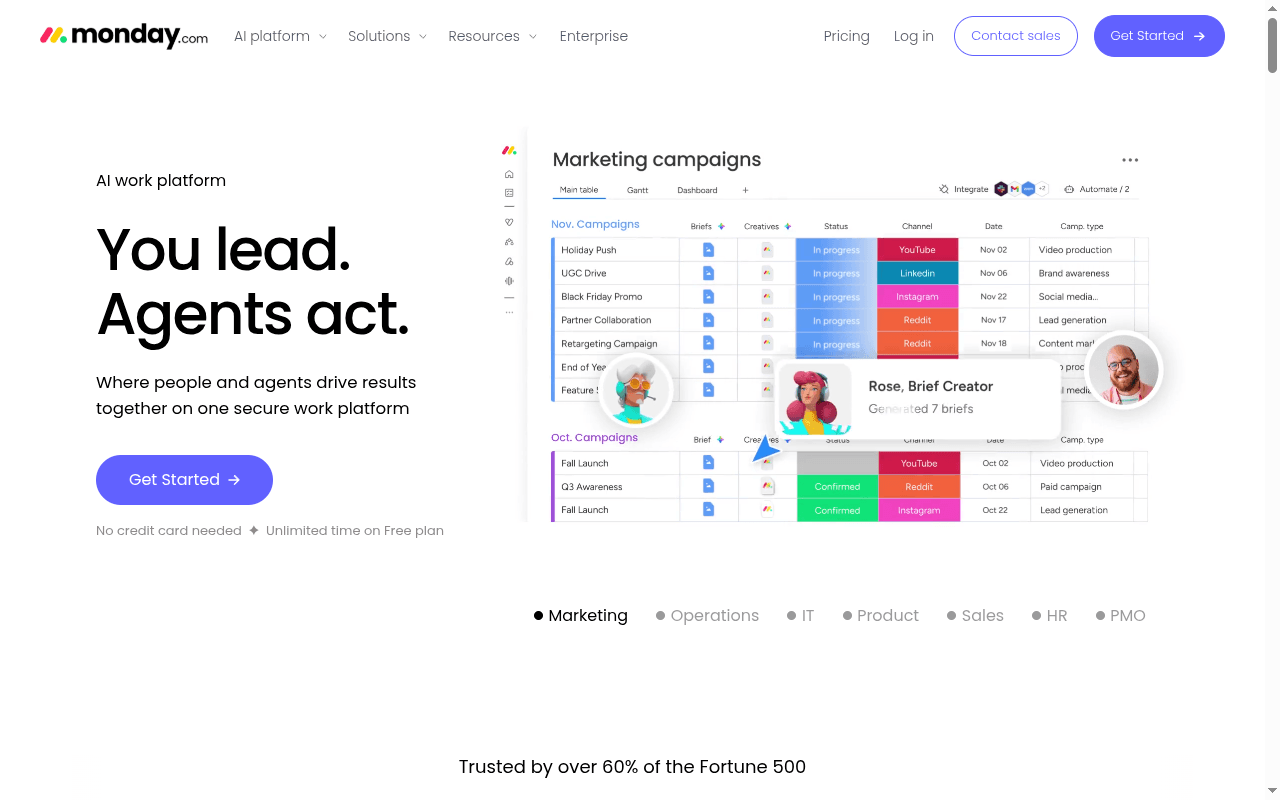
CL-3 did not fully pass (severity: low), but WHO ambiguity — not headline vagueness — was the primary failure. Evaluating the headline on its own terms: 'You lead. Agents act.' is a punchy brand line but contains no concrete outcome, no number, and no differentiation. It could apply to any AI automation product on the market in 2024–2025. There is no mechanism ('how'), no result ('so you can X'), and no specificity that separates monday.com from competitors.
Inject a concrete outcome or differentiator into the headline or an immediate supporting line. Example: 'You lead. Agents act. Ship projects 40% faster with AI that works inside your existing workflows.' Specificity — numbers, named outcomes, or a unique mechanism — dramatically increases perceived credibility.
Ogilvy, 'Ogilvy on Advertising' (1983), Chapter 7: 'The more informative your advertising, the more persuasive it will be.' Generic slogans sacrifice persuasion for cleverness.
- 3 · CL-5 · mediumJargon and insider terminology
Multiple unexplained technical terms cluster in the navigation and body without plain-language glosses: 'MCP' (appears in nav under 'Our infra' with no explanation anywhere in the visible copy), 'Vibe coding' (nav item — a niche developer term opaque to non-technical users), 'Agent builder' (nav — no definition), and 'AI agents' used throughout without a plain-language explanation of what an agent does vs. a traditional automation. The page explicitly targets multiple audiences — PMO, Marketing, Operations, IT, HR, Sales — meaning non-technical buyers (HR managers, Sales Directors) share the hero with developer-oriented terms like 'MCP' and 'Vibe coding'. This creates audience vocabulary tension.
Either (1) remove developer-specific terms (MCP, Vibe coding) from primary navigation visible to all audiences, or (2) add a one-line plain-language gloss on first use. For 'AI agents', add a parenthetical in the subhead or first body section: 'AI agents (software that takes action on your behalf)'. Reserve MCP and Vibe coding for a developer-specific section or sub-page.
CXL Institute, 'Conversion Copywriting' research — jargon that alienates even a subset of the target audience measurably reduces conversion; copy should be readable at the level of the least-technical buyer in the room.
All findings
7 findings shown · 9 of 16 checks passing
Authority signals verifiable
Press/authority claim detected (Trusted by) but the logos/text are not linked to verifiable sources.
Wrap each press logo or 'Featured in' badge in an <a href> pointing to the actual article or brand page. Unlinked authority claims invite scepticism — the reader cannot verify them.
Headline specificity
CL-3 did not fully pass (severity: low), but WHO ambiguity — not headline vagueness — was the primary failure. Evaluating the headline on its own terms: 'You lead. Agents act.' is a punchy brand line but contains no concrete outcome, no number, and no differentiation. It could apply to any AI automation product on the market in 2024–2025. There is no mechanism ('how'), no result ('so you can X'), and no specificity that separates monday.com from competitors.
Inject a concrete outcome or differentiator into the headline or an immediate supporting line. Example: 'You lead. Agents act. Ship projects 40% faster with AI that works inside your existing workflows.' Specificity — numbers, named outcomes, or a unique mechanism — dramatically increases perceived credibility.
Jargon and insider terminology
Multiple unexplained technical terms cluster in the navigation and body without plain-language glosses: 'MCP' (appears in nav under 'Our infra' with no explanation anywhere in the visible copy), 'Vibe coding' (nav item — a niche developer term opaque to non-technical users), 'Agent builder' (nav — no definition), and 'AI agents' used throughout without a plain-language explanation of what an agent does vs. a traditional automation. The page explicitly targets multiple audiences — PMO, Marketing, Operations, IT, HR, Sales — meaning non-technical buyers (HR managers, Sales Directors) share the hero with developer-oriented terms like 'MCP' and 'Vibe coding'. This creates audience vocabulary tension.
Either (1) remove developer-specific terms (MCP, Vibe coding) from primary navigation visible to all audiences, or (2) add a one-line plain-language gloss on first use. For 'AI agents', add a parenthetical in the subhead or first body section: 'AI agents (software that takes action on your behalf)'. Reserve MCP and Vibe coding for a developer-specific section or sub-page.
Real human faces present
Image alt texts reference only stylized AI agent avatars ('Stylized avatar of a Agent Hugo, Contract Reviewer', 'Stylized avatar of a Agent Nia, Vendor Researcher', etc.) — explicitly described as stylized/illustrated, not real human photos. The one named real customer (Alex Boulder, Director of Operations) in the social proof digest has no associated photo alt text. No 'Meet the team', founder headshots, or named customer photo alt texts are present anywhere in the page content or digest.
Add real headshot photos of named customers alongside their testimonials, and/or include a founder or team section with authentic photos. Ensure image alt texts for testimonial photos reference the person's name and role (e.g., 'Headshot of Alex Boulder, Director of Operations at [Company]') to reinforce authenticity signals.
Hero 5-second test
H1: 'You lead. Agents act.' Subhead: 'Where people and agents drive results together on one secure work platform'. WHAT is reasonably clear (an AI-powered work platform where AI agents execute tasks). WHO is not clear — 'people' is maximally broad, and the hero does not specify whether this is for enterprise teams, SMBs, project managers, or individuals. The role-specific examples (Nick, Emma, Sarah, Sophie, Mark, Jasmine) appear below the fold and do not rescue the hero.
Add a WHO qualifier to the subhead or hero label. For example: 'Where teams in marketing, IT, sales, and ops delegate work to AI agents — on one secure platform.' The 'AI work platform' label above the H1 is a start but too generic to anchor a specific audience.
Single message focus
Two distinct CTAs appear in the hero area: 'Get Started' (primary, acquisition-focused) and 'Get certified' (education/credentialing-focused). These serve different user intents — one is for new users evaluating the product, the other is for existing or prospective power users seeking certification. They do not lead to the same goal. However, 'Create your own solution' appears to be a secondary in-page interactive element rather than a competing acquisition CTA, so the core tension is between 'Get Started' and 'Get certified' appearing at the same visual level.
Demote 'Get certified' from the hero CTA set. Move it to a secondary section (e.g., a 'For power users' or 'Resources' band lower on the page). The hero should have one dominant CTA — 'Get Started' — with 'No credit card needed' as the only supporting copy. Certification is a retention/engagement play, not an acquisition hook.
Testimonials match target audience
Social proof digest contains one named testimonial: 'We replaced a 15-minute screening call with an AI agent that does it in 5 minutes. - Alex Boulder, Director of Operations Retail and CPG'. The body text features named personas (Nick, Operations Manager; Emma, IT Team Lead; Sarah, Product Manager; Sophie, Sales Director; Mark, HR Manager; Jasmine, Project Manager) but these appear to be illustrative UI demo characters, not real customer testimonials. Stat callouts ('25% Reduction in project timelines', '40% Faster production time') lack named individuals or company affiliations.
Add 2+ testimonials from real, named customers with explicit role titles, company names, and industry context that match monday.com's ICP (e.g., PMO leads at mid-market or enterprise companies, ops directors at Fortune 500 firms). Ensure each testimonial includes at minimum: full name, job title, company name, and ideally company size or industry vertical.
Independent automated analysis by PageLint. Not affiliated with or endorsed by Monday. Findings reflect the public landing page as fetched on July 17, 2026 and may not match the current version.
How this was scored: 16 Clarity and Trust checks, each tied to a cited source (see all checks). No brand paid to be here. Monday can request a re-audit at [email protected]. The Full Report ($29 one-time) runs all 55 checks. The free landing page checker runs the same 16 checks on any public URL.
See how your page scores on the same 16 checks
Paste your URL and get a score out of 100, with each finding quoted from your page and the source behind the rule. About 60 seconds, free, no signup.
Compare Monday
- Asana vs Monday: landing page copy compared · 80 vs 66 for Asana
More project management teardowns
- Trello landing page teardown · 90/100
- Basecamp landing page teardown · 85/100
- Jira landing page teardown · 79/100
Related research
- Market sophistication: Schwartz's 5 stages, 5 different copy strategies · 12 min read
- Schwartz awareness states explained · 18 min read
- Most-aware headlines: write the offer, not the pitch · 5 min read