Shopify landing page teardown: what to change
Shopify scores 76/100 on PageLint's quick copy audit — a solid result with clear room to tighten. Clarity is the stronger lens at 78/100, while Trust trails at 74/100. The biggest issue the engine flagged: “No objection-handlers present near any CTA” (TR-6, high severity).
What to change
- 1 · TR-6 · highNo objection-handlers present near any CTA
CTAs present: 'Start for free', 'Get started fast', 'Commerce for Agents'. No instances of 'no credit card required', 'cancel anytime', 'money-back guarantee', 'free trial', 'SOC 2', 'GDPR', 'no setup fee', or equivalent anxiety-reducing copy found anywhere in the page content or social proof digest. The only near-CTA context is 'Dream big and build fast on Shopify. The world's best commerce platform.' adjacent to 'Start for free'.
Place at least 2 objection-handlers directly beneath or adjacent to the primary 'Start for free' CTA — e.g., 'No credit card required · Cancel anytime'. Also consider adding a trust badge (SOC 2, GDPR) near the developer-facing CTA. This directly reduces purchase anxiety at the moment of decision.
CXL Institute anxiety lens research; Cialdini, R. (2001). Influence: The Psychology of Persuasion — reducing friction at the point of commitment.
- 2 · TR-4 · mediumAuthority signals verifiable
Press/authority claim detected (Trusted by) but the logos/text are not linked to verifiable sources.
Wrap each press logo or 'Featured in' badge in an <a href> pointing to the actual article or brand page. Unlinked authority claims invite scepticism — the reader cannot verify them.
Cialdini, Influence, Ch. 5 (Authority); Ogilvy
- 3 · CL-3 · mediumHero 5-second test
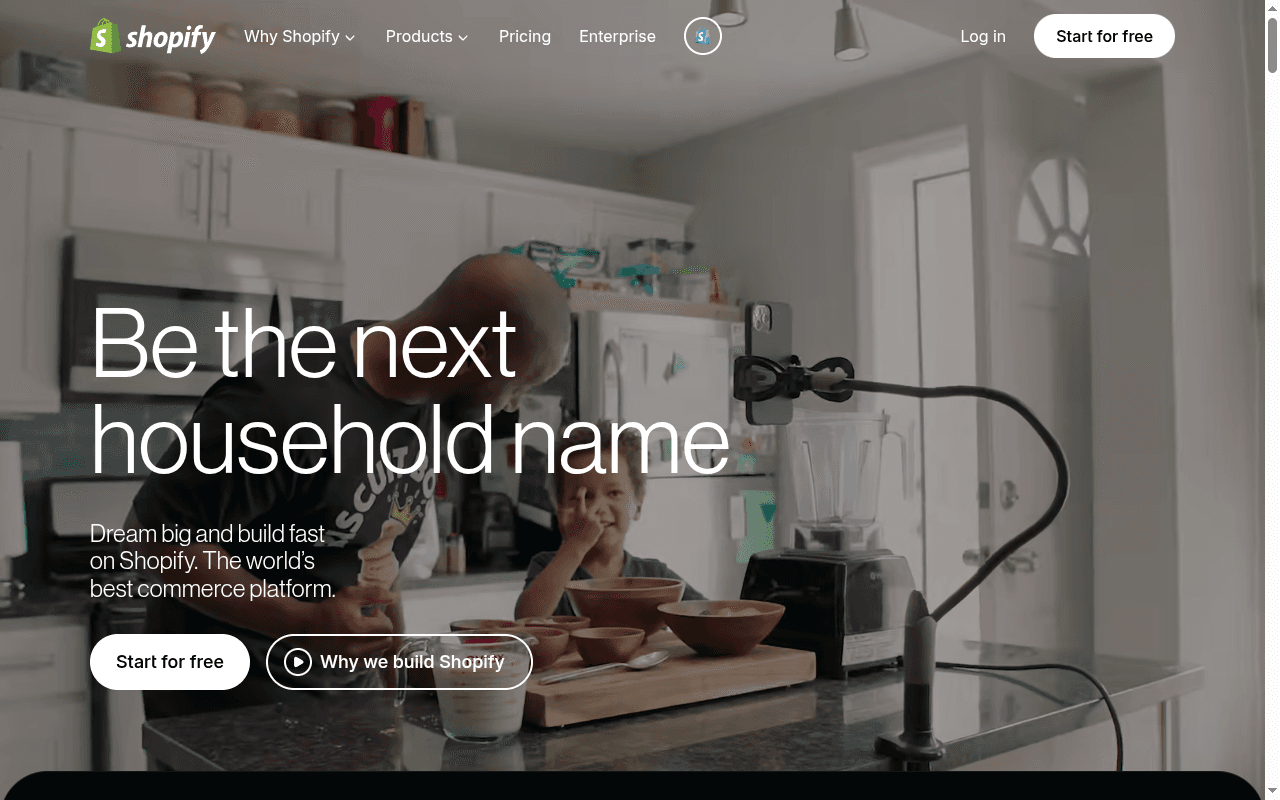
"Be the next AI all-star" — the rotating headline cycles through 'household name,' 'solo-preneur,' 'category creator,' 'global empire,' but none of these immediately communicate WHAT Shopify does to a first-time visitor. The subhead 'Dream big and build fast on Shopify. The world's best commerce platform.' does clarify the product category, but it sits below the fold-level hero text and requires the visitor to read past the ambiguous H1. WHAT (commerce platform) is eventually clear; WHO is scattered across too many rotating identities to land on any one audience.
Replace or anchor the H1 with a concrete statement of what Shopify does before the rotating identity reel. For example: 'Build your online store — and become the next [rotating identity].' This ensures WHAT is immediately legible and WHO is reinforced rather than obscured by the animation. The subhead should move up or be merged into the H1 structure so it is visible within 5 seconds without scrolling.
Ogilvy, 'Ogilvy on Advertising' (1983): 'On the average, five times as many people read the headline as read the body copy. It follows that unless your headline sells your product, you have wasted 90 percent of your money.'
Before → after
PageLint drafted these rewrites from the audited page text and the findings above. Treat them as proposals for Shopify to test. Any claim in them must match the company’s real terms.
The rotating headline never says what Shopify does. Anchoring it with the product first fixes the 5-second test (CL-3).
Merchants and developers get different offers, and they compete in the same view (CL-6).
No objection handler sits near any CTA (TR-6).
Expected impact
These rewrites target CL-3, CL-6, TR-6. If they ship, those checks should stop failing on a re-audit, which would lift the 76/100 score. We have not re-scored them yet and we do not claim a conversion lift, because we have no conversion data for Shopify.
All findings
7 findings shown · 9 of 16 checks passing
No objection-handlers present near any CTA
CTAs present: 'Start for free', 'Get started fast', 'Commerce for Agents'. No instances of 'no credit card required', 'cancel anytime', 'money-back guarantee', 'free trial', 'SOC 2', 'GDPR', 'no setup fee', or equivalent anxiety-reducing copy found anywhere in the page content or social proof digest. The only near-CTA context is 'Dream big and build fast on Shopify. The world's best commerce platform.' adjacent to 'Start for free'.
Place at least 2 objection-handlers directly beneath or adjacent to the primary 'Start for free' CTA — e.g., 'No credit card required · Cancel anytime'. Also consider adding a trust badge (SOC 2, GDPR) near the developer-facing CTA. This directly reduces purchase anxiety at the moment of decision.
Authority signals verifiable
Press/authority claim detected (Trusted by) but the logos/text are not linked to verifiable sources.
Wrap each press logo or 'Featured in' badge in an <a href> pointing to the actual article or brand page. Unlinked authority claims invite scepticism — the reader cannot verify them.
Hero 5-second test
"Be the next AI all-star" — the rotating headline cycles through 'household name,' 'solo-preneur,' 'category creator,' 'global empire,' but none of these immediately communicate WHAT Shopify does to a first-time visitor. The subhead 'Dream big and build fast on Shopify. The world's best commerce platform.' does clarify the product category, but it sits below the fold-level hero text and requires the visitor to read past the ambiguous H1. WHAT (commerce platform) is eventually clear; WHO is scattered across too many rotating identities to land on any one audience.
Replace or anchor the H1 with a concrete statement of what Shopify does before the rotating identity reel. For example: 'Build your online store — and become the next [rotating identity].' This ensures WHAT is immediately legible and WHO is reinforced rather than obscured by the animation. The subhead should move up or be merged into the H1 structure so it is visible within 5 seconds without scrolling.
Jargon and insider terminology
Multiple unexplained technical terms cluster in the body without plain-language glosses: 'Agentic Storefronts,' 'multichannel integration,' 'Shopify POS,' and 'Shopify Markets' all appear in close proximity. 'Agentic Storefronts' is the most problematic — it appears in a near-hero section ('Your brand has entered the chat / Your products get discovered across AI channels... All powered by Agentic Storefronts') with no parenthetical or plain-language explanation of what 'agentic' means. The page also explicitly targets a dual audience ('For anyone from entrepreneurs to enterprise'), meaning the vocabulary must work for non-technical first-time sellers who would not know what 'agentic' or 'multichannel integration' means without lookup.
Add a plain-language gloss immediately after 'Agentic Storefronts' — e.g., '(AI-powered storefronts that let shoppers buy directly inside chat interfaces).' For 'multichannel integration' and 'Shopify POS,' either spell out the acronym on first use ('Point of Sale') or replace with plain descriptors ('sell in your physical store'). Given the explicitly broad audience ('entrepreneurs to enterprise'), default to the least-technical reader in hero and near-hero sections.
Single message focus
The page presents at least three distinct CTAs leading to different offers or audiences: 'Start for free' (repeated three times for general sign-up), 'Get started fast' (tied to a specific merchant story), and 'Commerce for Agents — Build with our agent tools' (targeting developers). These are not aligned to the same goal — one targets end merchants starting a store, the other targets developers building on Shopify's API/agent infrastructure. A first-time visitor must make a meta-decision about which path applies to them before they can act.
Establish a single primary CTA ('Start for free') as the dominant action for the main audience (merchants), and move the developer-facing 'Commerce for Agents' CTA to a clearly separated section or secondary navigation link. If both audiences must be served on the same page, use a visible audience-selector or split-hero so visitors self-segment before encountering CTAs, eliminating the meta-decision.
Testimonials lack ICP-matching specificity
The only direct testimonial-style quote on the page is: 'Shopify Capital has given us the funding we need to stock up on inventory and grow rapidly.' — no name, no role, no company, no industry stated. Brand mentions (stevemadden.com, glossier.com, etc.) appear as logo-strip URLs without attributed quotes or personas. Case study references ('Jackie Prince launched Guests on Earth out of her home. Now it's a $4M+ business.', 'Our Place grew from a one-product shop into a cookware empire.', 'Iconic toymaker Mattel sells direct to shoppers all around the world.') are editorial narration, not first-person testimonials with role/company-size context.
Add 2–3 first-person testimonials that explicitly state the speaker's role (e.g., 'Founder', 'Head of eCommerce'), company type (DTC brand, B2B wholesaler, enterprise retailer), and business size or stage. This activates Cialdini's similarity amplifier — prospects self-identify with people like them and convert at higher rates.
No named individuals with roles or photos visible in content
The social proof digest contains one anonymous quote ('Shopify Capital has given us the funding we need to stock up on inventory and grow rapidly.') with no name or role attached. 'Jackie Prince' is mentioned in editorial narration ('Jackie Prince launched Guests on Earth out of her home') but without a role title, photo alt text, or first-person attribution. No 'Meet the team' section, no founder headshots, no named customer testimonials with company affiliations appear in the body or digest. Image alt texts reference brand website screenshots and product imagery, not individual headshots.
Add named customer testimonials with headshots, role titles, and company affiliations (e.g., 'Sarah Kim, Founder, Guests on Earth'). A short founder story section with a real photo also builds liking and familiarity. Ensure headshot alt text includes the person's name for accessibility and textual trust signals.
Independent automated analysis by PageLint. Not affiliated with or endorsed by Shopify. Findings reflect the public landing page as fetched on July 16, 2026 and may not match the current version.
How this was scored: 16 Clarity and Trust checks, each tied to a cited source (see all checks). No brand paid to be here. Shopify can request a re-audit at [email protected]. The Full Report ($29 one-time) runs all 55 checks. The free landing page checker runs the same 16 checks on any public URL.
See how your page scores on the same 16 checks
Paste your URL and get a score out of 100, with each finding quoted from your page and the source behind the rule. About 60 seconds, free, no signup.
More payments and commerce teardowns
- Stripe landing page teardown · 83/100