Slack landing page teardown: what to change
Slack scores 76/100 on PageLint's quick copy audit — a solid result with clear room to tighten. Clarity is the stronger lens at 82/100, while Trust trails at 69/100. The biggest issue the engine flagged: “Objections handled near CTA” (TR-6, high severity).
What to change
- 1 · TR-6 · highObjections handled near CTA
CTAs present on the page: 'Get started', 'Find your plan', 'Download Slack', 'Get Started Find Your Plan'. No objection-handling signals ('no credit card required', 'cancel anytime', 'money-back guarantee', 'free trial', 'SOC 2', 'GDPR', 'free plan', 'no setup fee') are found anywhere in the provided page content or social proof digest, either near or far from any CTA.
Add at least 2 objection-handlers directly adjacent to the primary CTA (e.g., beneath the 'Get started' button). Recommended additions: 'Free plan available — no credit card required' and 'Cancel anytime'. Optionally surface a security trust signal such as 'SOC 2 certified' or 'GDPR compliant' near the CTA to reduce enterprise buyer anxiety. These micro-copy elements have been shown by CXL Institute research to meaningfully reduce friction at the point of conversion.
CXL Institute anxiety lens research; Cialdini, R. (2001). Influence: The Psychology of Persuasion — reducing perceived risk lowers resistance to commitment.
- 2 · TR-4 · mediumAuthority signals verifiable
Press/authority claim detected (Trusted by) but the logos/text are not linked to verifiable sources.
Wrap each press logo or 'Featured in' badge in an <a href> pointing to the actual article or brand page. Unlinked authority claims invite scepticism — the reader cannot verify them.
Cialdini, Influence, Ch. 5 (Authority); Ogilvy
- 3 · CL-5 · mediumJargon and insider terminology
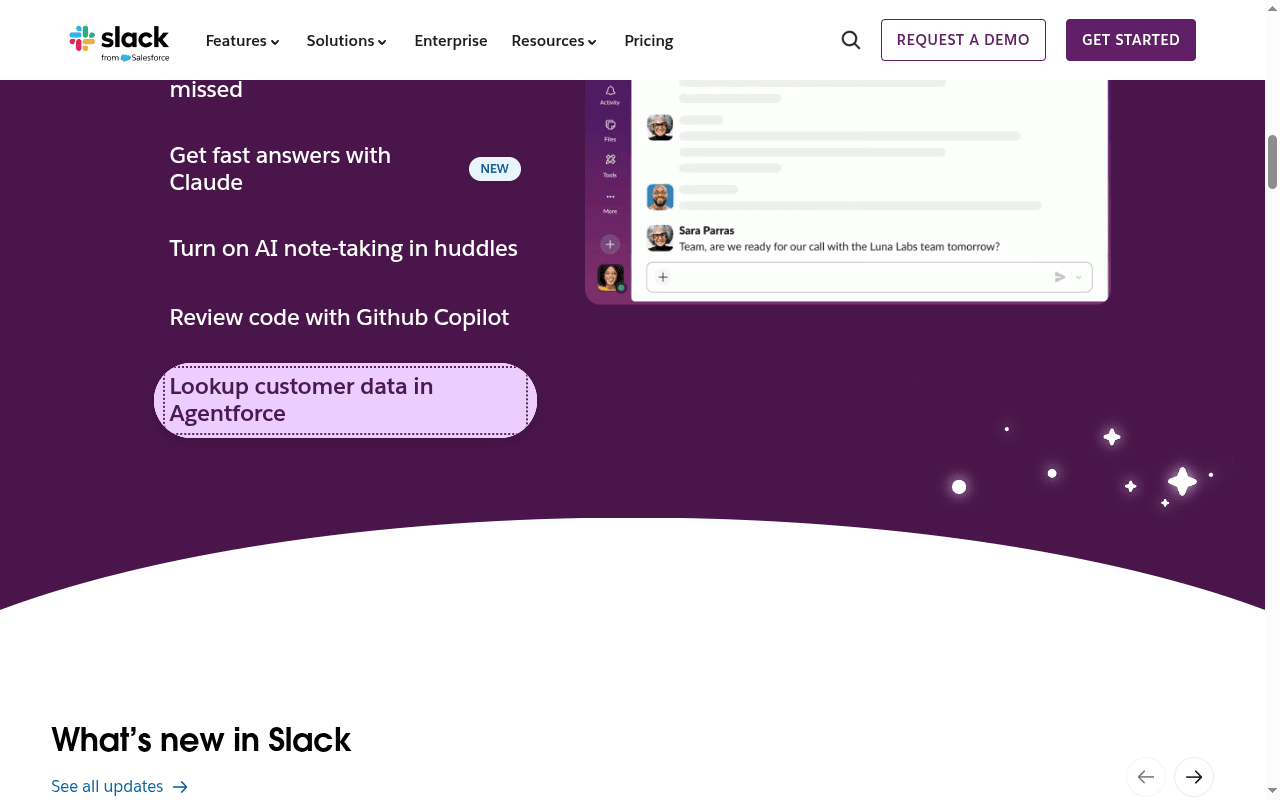
Multiple unexplained technical terms cluster in the hero and early body: 'AI agents' (H1, unexplained), 'Slackbot' (subhead, treated as self-evident), 'huddles' (body, no plain-language gloss), 'Agentforce' (body, no explanation), 'Claude' (body, no explanation), 'Github Copilot' (body, no explanation), 'CRM data' (body, no gloss). The page appears to target both non-technical business users ('Let your people connect like people') AND technically sophisticated users who know these product names. Non-technical buyers in the hero encounter 'AI agents' with no plain-language explanation of what an agent does or why it matters. A journalist from TechCrunch could summarize the page, but a mid-market operations manager encountering 'Agentforce' or 'AI agents' in the first scroll would need to look those up.
Add a one-sentence plain-language gloss for 'AI agents' in or immediately below the hero (e.g., 'AI agents are bots that take action on your behalf — no coding required'). For third-party product names (Claude, Agentforce, Github Copilot), either add a brief parenthetical or move them below the fold where context is richer. Resolve the dual-audience tension by choosing a primary voice: if targeting non-technical buyers, lead with outcomes, not product names.
CXL Institute, 'Landing Page Optimization' course (Peep Laja); Ogilvy, D. 'Confessions of an Advertising Man' (1963), Chapter 5: 'Write in the language your customer uses in everyday conversation.'
Before → after
PageLint drafted these rewrites from the audited page text and the findings above. Treat them as proposals for Slack to test. Any claim in them must match the company’s real terms.
Adds the missing WHAT and WHO to the hero (CL-3).
Explains "AI agents" and "Slackbot" in plain words (CL-5).
Feature links move down the page so the hero asks for one thing (CL-6).
Expected impact
These rewrites target CL-3, CL-5, CL-6. If they ship, those checks should stop failing on a re-audit, which would lift the 76/100 score. We have not re-scored them yet and we do not claim a conversion lift, because we have no conversion data for Slack.
All findings
7 findings shown · 9 of 16 checks passing
Objections handled near CTA
CTAs present on the page: 'Get started', 'Find your plan', 'Download Slack', 'Get Started Find Your Plan'. No objection-handling signals ('no credit card required', 'cancel anytime', 'money-back guarantee', 'free trial', 'SOC 2', 'GDPR', 'free plan', 'no setup fee') are found anywhere in the provided page content or social proof digest, either near or far from any CTA.
Add at least 2 objection-handlers directly adjacent to the primary CTA (e.g., beneath the 'Get started' button). Recommended additions: 'Free plan available — no credit card required' and 'Cancel anytime'. Optionally surface a security trust signal such as 'SOC 2 certified' or 'GDPR compliant' near the CTA to reduce enterprise buyer anxiety. These micro-copy elements have been shown by CXL Institute research to meaningfully reduce friction at the point of conversion.
Authority signals verifiable
Press/authority claim detected (Trusted by) but the logos/text are not linked to verifiable sources.
Wrap each press logo or 'Featured in' badge in an <a href> pointing to the actual article or brand page. Unlinked authority claims invite scepticism — the reader cannot verify them.
Jargon and insider terminology
Multiple unexplained technical terms cluster in the hero and early body: 'AI agents' (H1, unexplained), 'Slackbot' (subhead, treated as self-evident), 'huddles' (body, no plain-language gloss), 'Agentforce' (body, no explanation), 'Claude' (body, no explanation), 'Github Copilot' (body, no explanation), 'CRM data' (body, no gloss). The page appears to target both non-technical business users ('Let your people connect like people') AND technically sophisticated users who know these product names. Non-technical buyers in the hero encounter 'AI agents' with no plain-language explanation of what an agent does or why it matters. A journalist from TechCrunch could summarize the page, but a mid-market operations manager encountering 'Agentforce' or 'AI agents' in the first scroll would need to look those up.
Add a one-sentence plain-language gloss for 'AI agents' in or immediately below the hero (e.g., 'AI agents are bots that take action on your behalf — no coding required'). For third-party product names (Claude, Agentforce, Github Copilot), either add a brief parenthetical or move them below the fold where context is richer. Resolve the dual-audience tension by choosing a primary voice: if targeting non-technical buyers, lead with outcomes, not product names.
Single message focus
CTAs present: 'Get started', 'Find your plan', 'Download Slack' (appears 3 times), 'Templates — Start any task, fast', 'Canvas — Create rich, flexible docs'. These represent at least 3 distinct action types: downloading the app, exploring pricing, using a specific feature (Templates), and using a different specific feature (Canvas). Templates and Canvas lead to different product surfaces and imply different use cases, fragmenting visitor attention before a primary conversion is established.
Consolidate to one primary CTA in the hero ('Get started free' or 'Download Slack') and one secondary CTA ('See pricing'). Remove or relocate Templates and Canvas CTAs to their relevant feature sections further down the page. Feature-specific CTAs should appear only after the visitor has been convinced of the core value prop. Ogilvy's principle: one advertisement, one promise.
Testimonials match target audience
Two named testimonials are present: 'Slack has been essential to our growth, our speed, and our ability to stay aligned as we scale' — Kate Jenson, Head of Americas, Anthropic; and 'Work starts in conversation. That's why we see Slack as the natural place to build our agents.' — Guillermo Rauch, CEO, Vercel. Additionally, company case study references include Box, Rivian, Caraway, and MrBeast. Logo strip includes GM, OpenAI, Target, Paramount, Stripe, IBM.
Add 2–3 testimonials from personas that more explicitly match Slack's core ICP segments (e.g., a VP of Engineering at a mid-market SaaS company, an HR leader at an enterprise, or a team lead at a fast-growing startup). The current testimonials skew toward high-profile tech CEOs and a content creator (MrBeast), which may not resonate with the typical buyer — a team manager or IT decision-maker at a mid-to-large company. Include role, company size, and a specific workflow pain point in each testimonial.
Hero 5-second test
H1: 'All your people and AI agents working together.' Subhead: 'Slack connects your team. Slackbot multiplies what they can do.' WHAT is reasonably clear (a team communication/collaboration platform with AI). WHO is unclear — 'your team' and 'your people' are maximally generic and do not signal whether this is for enterprise IT buyers, SMB founders, developers, or knowledge workers.
Add a WHO qualifier to the hero — either in the H1 or subhead — that names the target user. For example: 'The collaboration hub for business teams' or 'Where [company size/type] teams get work done.' Ogilvy consistently argued that the headline must select the right prospect; a headline that speaks to everyone speaks to no one.
Real human faces present
Two named individuals with roles and company affiliations appear in testimonials: Kate Jenson (Head of Americas, Anthropic) and Guillermo Rauch (CEO, Vercel). No 'Meet the team' section, founder photos, or headshot alt text patterns are present in the content. Image alt texts reference UI screenshots and company logos, not individual headshots.
Add headshots alongside the two existing named testimonials (Kate Jenson and Guillermo Rauch) and consider adding a founder or leadership section with real named photos. Verified, named faces with titles significantly increase perceived authenticity and liking. If customer headshots are available, include them with name, title, and company to reinforce the human connection.
Independent automated analysis by PageLint. Not affiliated with or endorsed by Slack. Findings reflect the public landing page as fetched on July 16, 2026 and may not match the current version.
How this was scored: 16 Clarity and Trust checks, each tied to a cited source (see all checks). No brand paid to be here. Slack can request a re-audit at [email protected]. The Full Report ($29 one-time) runs all 55 checks. The free landing page checker runs the same 16 checks on any public URL.
See how your page scores on the same 16 checks
Paste your URL and get a score out of 100, with each finding quoted from your page and the source behind the rule. About 60 seconds, free, no signup.
More communication teardowns
- Intercom landing page teardown · 85/100
- Loom landing page teardown · 82/100
- Calendly landing page teardown · 77/100