Zoom landing page teardown: what to change
Zoom scores 71/100 on PageLint's quick copy audit — a mixed result — strong in places, leaky in others. Clarity is the stronger lens at 73/100, while Trust trails at 69/100. The biggest issue the engine flagged: “Single message focus” (CL-6, high severity).
What to change
- 1 · CL-6 · highSingle message focus
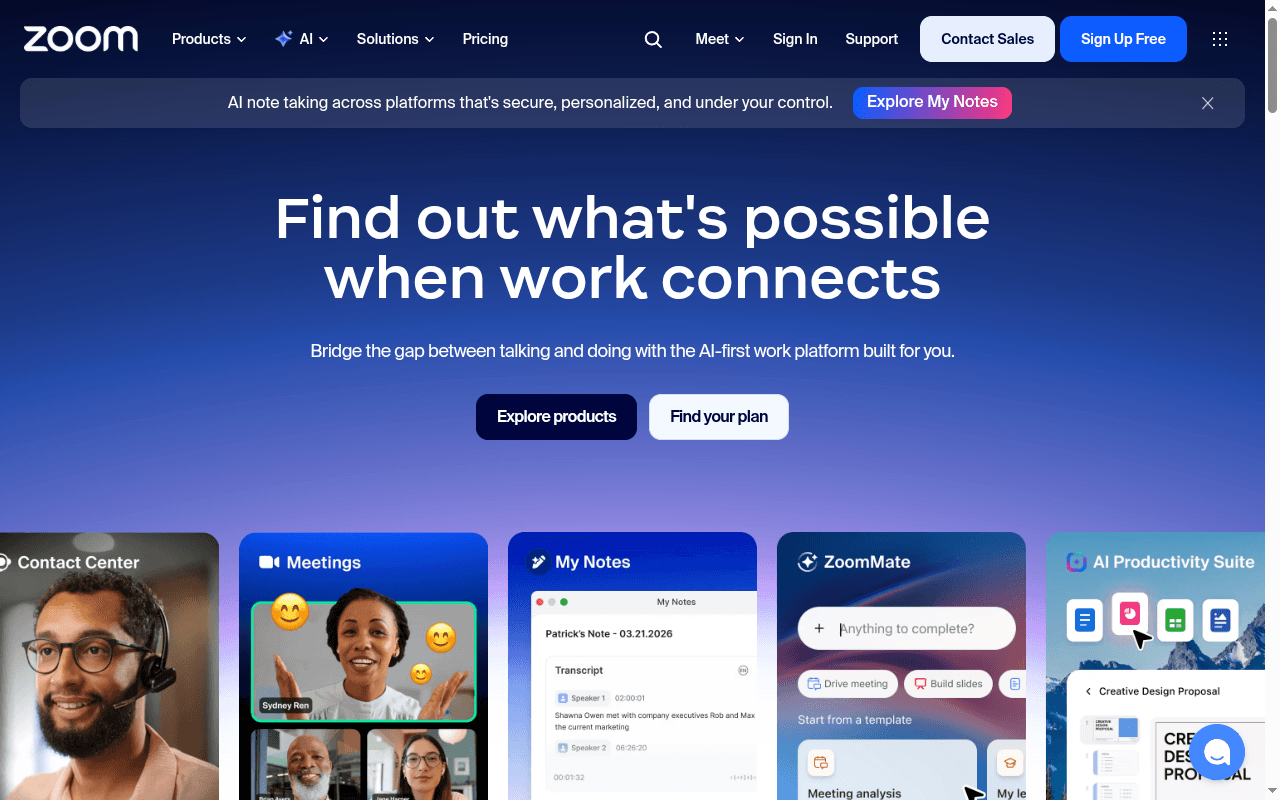
The hero alone contains five distinct CTAs: 'Sign Up Free', 'Download on the App Store', 'Get it on Google Play', 'Join a meeting', 'Download app'. Beyond the hero, the page presents at least two additional 'Explore products' CTAs plus 'Find your plan'. A first-time visitor faces a meta-decision: Am I signing up for a new account, downloading a mobile app, joining someone else's meeting, or exploring an enterprise product suite? These CTAs lead to fundamentally different user journeys and different products.
Establish one primary CTA for the dominant visitor intent (new user acquisition: 'Sign Up Free') and demote all secondary actions. 'Join a meeting' should be moved to a persistent but visually subordinate link (e.g., top-right nav). App store badges can appear below the fold or on a dedicated mobile page. Reduce hero CTAs to one primary button and at most one secondary text link to eliminate the meta-decision.
Ogilvy, 'Confessions of an Advertising Man' (1963): 'You cannot bore people into buying your product; you can only interest them in buying it.' Fragmenting attention across competing offers is the structural equivalent of boring the visitor into inaction. Also supported by CXL Institute research on CTA hierarchy: pages with a single dominant CTA consistently outperform multi-CTA layouts in conversion rate tests.
- 2 · TR-6 · highObjections handled near CTA
CTAs present: 'Sign Up Free', 'Download on the App Store', 'Get it on Google Play', 'Join a meeting', 'Download app'. No objection-handling signals ('no credit card required', 'cancel anytime', 'money-back guarantee', '14-day free trial', 'SOC 2', 'GDPR', 'free plan', 'no setup fee') were found anywhere in the provided page content or social proof digest.
Place at least 2 distinct objection-handlers immediately adjacent to the primary 'Sign Up Free' CTA — for example, 'No credit card required' and 'Cancel anytime' as microcopy beneath the button. Additionally, consider adding a trust badge (SOC 2 or GDPR) nearby to address security anxiety for enterprise buyers.
CXL Institute anxiety lens research; Cialdini, R. (2001). Influence: The Psychology of Persuasion — reducing perceived risk at the moment of decision lowers friction and increases conversion.
- 3 · TR-4 · mediumAuthority signals verifiable
Press/authority claim detected (Trusted by) but the logos/text are not linked to verifiable sources.
Wrap each press logo or 'Featured in' badge in an <a href> pointing to the actual article or brand page. Unlinked authority claims invite scepticism — the reader cannot verify them.
Cialdini, Influence, Ch. 5 (Authority); Ogilvy
Before → after
PageLint drafted these rewrites from the audited page text and the findings above. Treat them as proposals for Zoom to test. Any claim in them must match the company’s real terms.
The original does not say what Zoom sells (CL-3).
Replaces "AI-first work platform" with what a visitor does with it (CL-3, CL-5).
Five hero CTAs become one primary and one secondary (CL-6).
Expected impact
These rewrites target CL-3, CL-5, CL-6. If they ship, those checks should stop failing on a re-audit, which would lift the 71/100 score. We have not re-scored them yet and we do not claim a conversion lift, because we have no conversion data for Zoom.
All findings
7 findings shown · 9 of 16 checks passing
Single message focus
The hero alone contains five distinct CTAs: 'Sign Up Free', 'Download on the App Store', 'Get it on Google Play', 'Join a meeting', 'Download app'. Beyond the hero, the page presents at least two additional 'Explore products' CTAs plus 'Find your plan'. A first-time visitor faces a meta-decision: Am I signing up for a new account, downloading a mobile app, joining someone else's meeting, or exploring an enterprise product suite? These CTAs lead to fundamentally different user journeys and different products.
Establish one primary CTA for the dominant visitor intent (new user acquisition: 'Sign Up Free') and demote all secondary actions. 'Join a meeting' should be moved to a persistent but visually subordinate link (e.g., top-right nav). App store badges can appear below the fold or on a dedicated mobile page. Reduce hero CTAs to one primary button and at most one secondary text link to eliminate the meta-decision.
Objections handled near CTA
CTAs present: 'Sign Up Free', 'Download on the App Store', 'Get it on Google Play', 'Join a meeting', 'Download app'. No objection-handling signals ('no credit card required', 'cancel anytime', 'money-back guarantee', '14-day free trial', 'SOC 2', 'GDPR', 'free plan', 'no setup fee') were found anywhere in the provided page content or social proof digest.
Place at least 2 distinct objection-handlers immediately adjacent to the primary 'Sign Up Free' CTA — for example, 'No credit card required' and 'Cancel anytime' as microcopy beneath the button. Additionally, consider adding a trust badge (SOC 2 or GDPR) nearby to address security anxiety for enterprise buyers.
Authority signals verifiable
Press/authority claim detected (Trusted by) but the logos/text are not linked to verifiable sources.
Wrap each press logo or 'Featured in' badge in an <a href> pointing to the actual article or brand page. Unlinked authority claims invite scepticism — the reader cannot verify them.
Hero 5-second test
"Find out what's possible when work connects" / "Bridge the gap between talking and doing with the AI-first work platform built for you." — WHAT is unclear (an 'AI-first work platform' is vague enough that a first-time visitor cannot immediately distinguish this from a project management tool, a chat app, or a CRM). WHO is implied ('built for you' is non-specific). A visitor unfamiliar with Zoom's expansion beyond video meetings would not know within 5 seconds that this covers meetings, phone, contact center, webinars, and AI productivity in one suite.
Rewrite the H1 and subhead to name the core product category and primary audience explicitly. For example: 'Video meetings, phone, and AI tools — one platform for teams of any size.' The subhead should name at least one concrete capability so the visitor can anchor their understanding immediately.
Jargon and insider terminology
Multiple unexplained technical and product-specific terms cluster together in the hero and early body: 'AI-first work platform', 'UCaaS platform', 'ZoomMate', 'Virtual Agent', 'multi-intent questions', 'CX', 'BrightHire', 'Bonsai'. 'UCaaS' appears in body copy with no plain-language gloss ('Seamless communication: Save time and cut costs with Meetings, Phone, Chat, and more, in one UCaaS platform.'). The page also targets dual audiences — individual knowledge workers AND enterprise IT/contact-center buyers — but uses enterprise/technical vocabulary (UCaaS, CRM integration, real-time analytics, conversation insights, multi-intent) that will alienate the SMB or individual user segment.
1) Replace 'UCaaS platform' with 'all-in-one communications platform (calls, chat, meetings)' on first use. 2) Introduce 'ZoomMate', 'BrightHire', and 'Bonsai' with one-line plain-language descriptors before using the brand names. 3) Replace 'multi-intent questions' with 'complex, multi-part customer questions'. 4) Spell out 'CX' as 'customer experience (CX)' on first use. 5) Consider separate landing paths for individual/SMB vs. enterprise contact-center buyers to avoid vocabulary tension.
Testimonials match target audience
Noah Garden, Chief Revenue Officer (Major League Baseball); Tan Han Sing, Founder and CEO, TheShareCo; Taylor Nelson, Member Care QA Specialist (Cricut); Nikita Steals, VP, Tech Talent Acquisition, Capital One.
The ICP for Zoom's homepage appears to span enterprise IT buyers, RevOps leaders, and HR/employee-engagement personas. While Capital One (Nikita Steals, VP Tech Talent) and Cricut (Taylor Nelson, QA Specialist) align reasonably well, MLB and TheShareCo skew toward niche/consumer-adjacent use cases. Add 2–3 testimonials from mid-market or enterprise decision-makers (e.g., CIOs, IT Directors, or Operations VPs) explicitly calling out the business outcome to sharpen ICP alignment across the board.
Real human faces present
Named individuals with roles and company affiliations appear in testimonials: 'Noah Garden, Chief Revenue Officer'; 'Tan Han Sing, Founder and CEO, TheShareCo'; 'Taylor Nelson, Member Care QA Specialist'; 'Nikita Steals, VP, Tech Talent Acquisition, Capital One'. Image alt texts reference a 'Screenshot of contact center software showing a man providing virtual customer service' but no named headshot alt texts are present. Social proof digest confirms: 'Tan Han Sing, Founder' and 'Nikita Steals, VP' appear as named individuals.
Add visible headshots alongside each named testimonial with descriptive alt text (e.g., 'Photo of Nikita Steals, VP Tech Talent Acquisition at Capital One') to reinforce human familiarity. A short 'Meet the team' or founder section with real photos would further strengthen trust signals.
Independent automated analysis by PageLint. Not affiliated with or endorsed by Zoom. Findings reflect the public landing page as fetched on July 17, 2026 and may not match the current version.
How this was scored: 16 Clarity and Trust checks, each tied to a cited source (see all checks). No brand paid to be here. Zoom can request a re-audit at [email protected]. The Full Report ($29 one-time) runs all 55 checks. The free landing page checker runs the same 16 checks on any public URL.
See how your page scores on the same 16 checks
Paste your URL and get a score out of 100, with each finding quoted from your page and the source behind the rule. About 60 seconds, free, no signup.
More communication teardowns
- Intercom landing page teardown · 85/100
- Loom landing page teardown · 82/100
- Calendly landing page teardown · 77/100