Miro landing page teardown: what to change
Miro scores 80/100 on PageLint's quick copy audit — a solid result with clear room to tighten. Trust is the stronger lens at 91/100, while Clarity trails at 70/100. The biggest issue the engine flagged: “Single dominant H1” (CL-1, medium severity).
What to change
- 1 · CL-1 · mediumSingle dominant H1
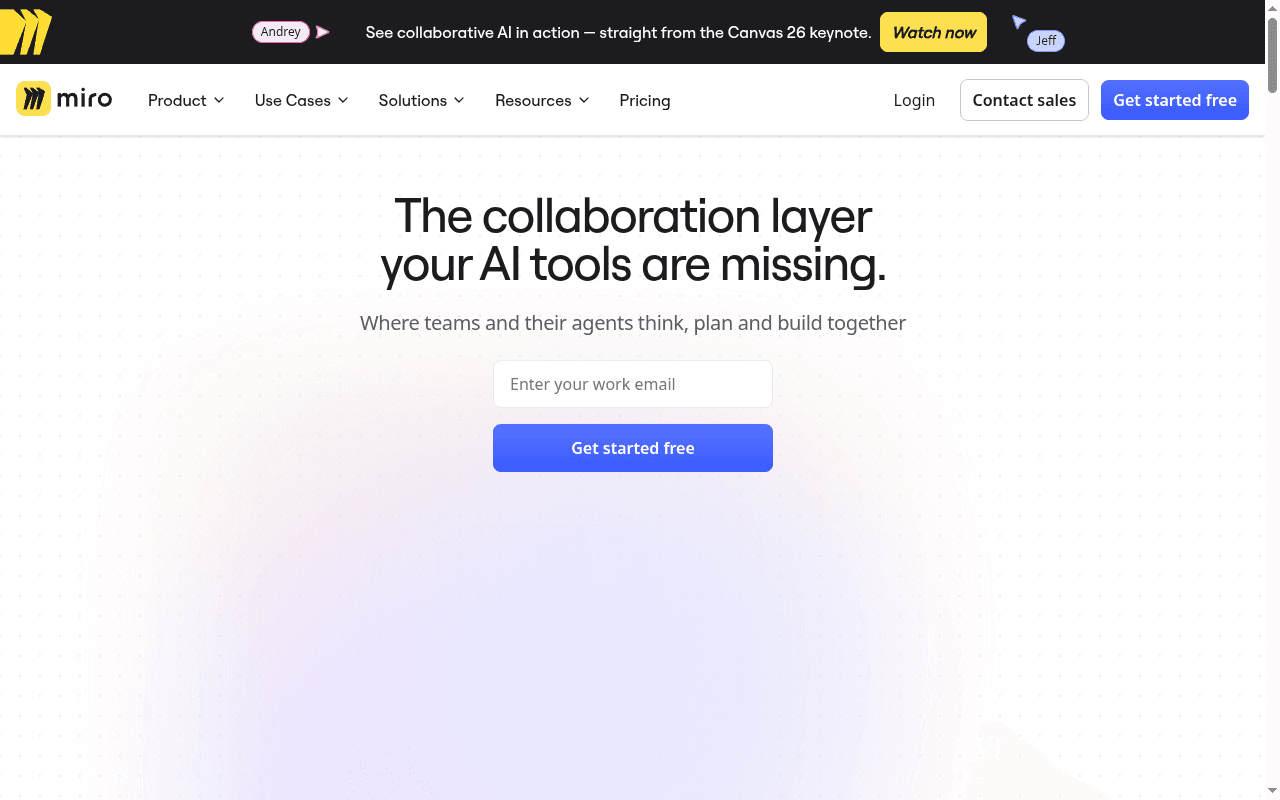
Found 5 H1 tags: ['The collaboration layer your AI tools are missing.', 'Research', 'Roadmaps']
Use only one H1 per page. Demote secondary H1s to H2.
Ogilvy, Confessions of an Advertising Man, Ch. VI
- 2 · CL-3 · mediumHero 5-second test
H1: 'The collaboration layer your AI tools are missing.' Subhead: 'Where teams and their agents think, plan and build together.' WHAT is partially clear (a collaboration tool that connects AI tools), but 'collaboration layer' is an abstract architectural metaphor that requires inference. WHO is entirely absent — no mention of team type, role, or industry. A first-time visitor cannot confirm within 5 seconds whether this is for product teams, enterprises, developers, or general knowledge workers.
Rewrite the H1 to name a concrete outcome and a specific audience. Example: 'The visual workspace where product teams plan, build, and ship — together with AI.' Add a subhead that names the primary user persona (e.g., 'Built for product managers, designers, and engineers who move fast').
Ogilvy, 'Ogilvy on Advertising' (1983): 'The headline is the ticket on the meat. Use it to flag down the readers who are prospects for the kind of product you are advertising.' CXL Institute, 'Above the Fold' research: pages that fail to communicate WHO within 5 seconds see significantly higher bounce rates.
- 3 · CL-5 · mediumJargon and insider terminology
Multiple unexplained technical terms cluster in the hero and early body: 'collaboration layer' (architectural metaphor with no plain-language gloss), 'agents' ('teams and their agents think, plan and build together' — AI agents undefined), 'multiplayer canvas' (gaming metaphor applied to SaaS, unexplained), 'Blueprints' (used as a product feature name with no plain-language definition: 'Automate key processes and ensure your workflows are scalable, repeatable, and efficient'). The page also references 'Claude, NotebookLM' as known entities without explanation. The page appears to target both non-technical business users and technically sophisticated AI-tool users simultaneously, but the hero vocabulary ('collaboration layer,' 'agents') skews toward the technical audience, creating audience tension.
Add a one-sentence plain-language gloss immediately after 'collaboration layer' in the hero — e.g., 'A shared visual workspace that connects your team's AI tools, research, and planning in one place.' Replace 'agents' with 'AI assistants' on first use, or add a parenthetical. Audit each feature name (Blueprints, Intelligent Canvas) to ensure the subtitle explains the benefit in plain language before using the branded term.
CXL Institute, Peep Laja: 'If your value proposition requires the visitor to already understand your category, you've lost the majority of your audience before they scroll.' Ogilvy, 'Confessions of an Advertising Man' (1963): 'The consumer is not a moron; she is your wife. You insult her intelligence if you assume that a mere slogan and a few vapid adjectives will persuade her to buy anything.'
All findings
7 findings shown · 9 of 16 checks passing
Single dominant H1
Found 5 H1 tags: ['The collaboration layer your AI tools are missing.', 'Research', 'Roadmaps']
Use only one H1 per page. Demote secondary H1s to H2.
Hero 5-second test
H1: 'The collaboration layer your AI tools are missing.' Subhead: 'Where teams and their agents think, plan and build together.' WHAT is partially clear (a collaboration tool that connects AI tools), but 'collaboration layer' is an abstract architectural metaphor that requires inference. WHO is entirely absent — no mention of team type, role, or industry. A first-time visitor cannot confirm within 5 seconds whether this is for product teams, enterprises, developers, or general knowledge workers.
Rewrite the H1 to name a concrete outcome and a specific audience. Example: 'The visual workspace where product teams plan, build, and ship — together with AI.' Add a subhead that names the primary user persona (e.g., 'Built for product managers, designers, and engineers who move fast').
Jargon and insider terminology
Multiple unexplained technical terms cluster in the hero and early body: 'collaboration layer' (architectural metaphor with no plain-language gloss), 'agents' ('teams and their agents think, plan and build together' — AI agents undefined), 'multiplayer canvas' (gaming metaphor applied to SaaS, unexplained), 'Blueprints' (used as a product feature name with no plain-language definition: 'Automate key processes and ensure your workflows are scalable, repeatable, and efficient'). The page also references 'Claude, NotebookLM' as known entities without explanation. The page appears to target both non-technical business users and technically sophisticated AI-tool users simultaneously, but the hero vocabulary ('collaboration layer,' 'agents') skews toward the technical audience, creating audience tension.
Add a one-sentence plain-language gloss immediately after 'collaboration layer' in the hero — e.g., 'A shared visual workspace that connects your team's AI tools, research, and planning in one place.' Replace 'agents' with 'AI assistants' on first use, or add a parenthetical. Audit each feature name (Blueprints, Intelligent Canvas) to ensure the subtitle explains the benefit in plain language before using the branded term.
Single message focus
Four distinct CTAs appear in the navigation/hero area alone: 'Download Apps,' 'Get started free,' 'Templates — Get started fast,' 'Academy — Get started with Miro.' These lead to different destinations (app download, account creation, template library, learning platform) and represent different stages of the funnel. A first-time visitor faces a meta-decision: should I download an app, sign up, browse templates, or take a course? The body then adds 'Explore research,' 'Learn more' (×4 for different features), and 'Read Customer Study,' further fragmenting attention.
Establish one dominant primary CTA in the hero — 'Get started free' is the highest-intent action and should be the sole button above the fold. Move 'Download Apps,' 'Templates,' and 'Academy' to the navigation or a secondary section below the fold. Apply Ogilvy's principle of one dominant idea per ad: every element on the hero should support the single conversion goal of free sign-up.
Testimonials match target audience
Only one named testimonial is present: 'Being able to bring everyone together to plan in Miro ultimately means that the most impactful initiatives will happen at the right time – and customers will get the functionality they want.' — Lucy Starling, Product Operations Lead at ASOS. No other named testimonials with roles or company types appear in the body or social proof digest.
Add at least 2 more testimonials from clearly identified personas matching Miro's ICP (e.g., product managers, engineering leads, or design directors at mid-to-large tech or enterprise companies). Include role, company name, and ideally company size or industry to activate the similarity amplifier. Consider adding testimonials from different ICP segments such as a CTO at a SaaS company or a UX lead at an enterprise firm.
Objections handled near CTA
The text 'No credit card needed.' appears near the primary 'Get started free' CTA in the hero section. The social proof digest confirms 'SOC 2 COMPLIANT' and 'GDPR COMPLIANT' as image alt texts, but these appear to be located in a separate trust/security section (not adjacent to the CTA). No other objection-handlers such as 'cancel anytime', 'money-back guarantee', or 'free plan' are found near the CTA.
Add at least one more objection-handler directly adjacent to the primary CTA — for example, 'Cancel anytime' or 'Free plan available' placed as microcopy beneath or beside the 'Get started free' button. Relocating or duplicating the SOC 2 and GDPR badges near the CTA would also help reach the 2+ threshold within a single viewport.
Real human faces present
Several first names appear in the body content — 'Andrey', 'Jeff', 'Jess', 'Drew', 'Brie' — suggesting named individuals, possibly with headshots, in UI mockups or testimonial contexts. One fully attributed testimonial exists: Lucy Starling, Product Operations Lead at ASOS. However, no roles, titles, or company affiliations are provided for Andrey, Jeff, Jess, Drew, or Brie, and no 'Meet the team' or founder section is present.
Ensure that named individuals shown in the UI or testimonial sections include their full name, role, and company affiliation in visible text (not just image alt text). Add a founder or team section with named photos and titles to strengthen human familiarity signals. Confirm that photos used are authentic rather than stock imagery.
Independent automated analysis by PageLint. Not affiliated with or endorsed by Miro. Findings reflect the public landing page as fetched on July 16, 2026 and may not match the current version.
How this was scored: 16 Clarity and Trust checks, each tied to a cited source (see all checks). No brand paid to be here. Miro can request a re-audit at [email protected]. The Full Report ($29 one-time) runs all 55 checks. The free landing page checker runs the same 16 checks on any public URL.
See how your page scores on the same 16 checks
Paste your URL and get a score out of 100, with each finding quoted from your page and the source behind the rule. About 60 seconds, free, no signup.
Compare Miro
- Figma vs Miro: landing page copy compared · 80 vs 69 for Figma
- Canva vs Miro: landing page copy compared · 80 vs 69 for Canva
More design teardowns
- Canva landing page teardown · 69/100
- Figma landing page teardown · 69/100