Coda landing page teardown: what to change
Coda scores 74/100 on PageLint's quick copy audit — a mixed result — strong in places, leaky in others. Clarity is the stronger lens at 79/100, while Trust trails at 68/100. The biggest issue the engine flagged: “Testimonials match target audience” (TR-2, high severity).
What to change
- 1 · TR-2 · highTestimonials match target audience
Only one attributed testimonial present: '"It's more powerful than Google Docs and more flexible than Airtable or Notion." - Fast Company'. No role, company type, or industry context provided for the speaker. Logo strip shows company names (Figma, New York Times, Square, Robinhood, BuzzFeed, TED, Uber) but no individual testimonials with matching ICP signals (team size, role, use case, or industry explicitly stated).
Add 2+ customer testimonials with explicit role/title, company size, and industry. Example: 'Sarah Chen, Product Manager at [Mid-Market SaaS], uses Coda to centralize product decisions across 12-person team.' Include headshots with names to amplify social proof similarity.
Cialdini, R. B. (2001). Influence: The Psychology of Persuasion. Ch. 4 — Social Proof. Similarity amplifier: people are more influenced by proof from similar others.
- 2 · TR-6 · highObjections handled near CTA
Primary CTAs ('Get started for free', 'Contact sales', 'Get started') appear in hero and throughout page. Near these CTAs, zero objection-handlers are present. No mention of 'no credit card required', 'cancel anytime', 'money-back guarantee', 'free trial', 'SOC 2', 'GDPR', 'free plan', or 'no setup fee' within the same section or immediately adjacent to any CTA.
Add objection-handling copy immediately below or adjacent to primary CTAs. Example: 'Get started for free — no credit card required. Cancel anytime.' Include trust badges (SOC 2, GDPR) or trial length ('14-day free trial') near the hero CTA to reduce purchase anxiety.
CXL Institute Anxiety Lens Research + Cialdini, R. B. (2001). Influence: The Psychology of Persuasion. Removing friction objections increases conversion by addressing commitment anxiety.
- 3 · CL-5 · mediumJargon and insider terminology
Multiple unexplained technical terms cluster in body copy without plain-language gloss: 'AI Views,' 'AI column,' 'formula, button, or automation,' 'personalized views,' 'edits sync everywhere.' The page also uses 'Replaces' labels (Writeups, Hubs, Trackers, Applications) that assume familiarity with Coda's taxonomy. A non-user cannot decode what 'AI Views' or 'AI column' actually do without clicking through. Secondary audience tension: the hero targets 'teams' broadly, but the feature descriptions assume users already understand Coda's data model.
Add one-line plain-language explanations in parentheses for each feature. Example: 'AI Views (automatically organize your data based on what matters most)' and 'AI column (auto-fill repetitive data fields).' This allows both new and existing users to scan quickly.
CXL Institute, 'Conversion Copywriting' research: 'Jargon in the hero or early body copy reduces comprehension by 30%+ for secondary audiences. Always provide a plain-language gloss.'
Before → after
PageLint drafted these rewrites from the audited page text and the findings above. Treat them as proposals for Coda to test. Any claim in them must match the company’s real terms.
"All-in-one workspace" fits almost any SaaS tool. The rewrite names the three things you actually build in Coda (CL-4).
"Teams" is the only audience named, and "a more organized work day" is not an outcome a visitor can check (CL-3).
Several buttons compete, and none answers the cost question next to the button. Objection handling near the CTA is a high-severity miss (CL-6, TR-6).
The only quote comes from a publication. No named person with a role vouches for the product (TR-2).
Expected impact
These rewrites target CL-4, CL-3, CL-6, TR-6, TR-2. If they ship, those checks should stop failing on a re-audit, which would lift the 74/100 score. We have not re-scored them yet and we do not claim a conversion lift, because we have no conversion data for Coda.
All findings
7 findings shown · 8 of 16 checks passing
Testimonials match target audience
Only one attributed testimonial present: '"It's more powerful than Google Docs and more flexible than Airtable or Notion." - Fast Company'. No role, company type, or industry context provided for the speaker. Logo strip shows company names (Figma, New York Times, Square, Robinhood, BuzzFeed, TED, Uber) but no individual testimonials with matching ICP signals (team size, role, use case, or industry explicitly stated).
Add 2+ customer testimonials with explicit role/title, company size, and industry. Example: 'Sarah Chen, Product Manager at [Mid-Market SaaS], uses Coda to centralize product decisions across 12-person team.' Include headshots with names to amplify social proof similarity.
Objections handled near CTA
Primary CTAs ('Get started for free', 'Contact sales', 'Get started') appear in hero and throughout page. Near these CTAs, zero objection-handlers are present. No mention of 'no credit card required', 'cancel anytime', 'money-back guarantee', 'free trial', 'SOC 2', 'GDPR', 'free plan', or 'no setup fee' within the same section or immediately adjacent to any CTA.
Add objection-handling copy immediately below or adjacent to primary CTAs. Example: 'Get started for free — no credit card required. Cancel anytime.' Include trust badges (SOC 2, GDPR) or trial length ('14-day free trial') near the hero CTA to reduce purchase anxiety.
Jargon and insider terminology
Multiple unexplained technical terms cluster in body copy without plain-language gloss: 'AI Views,' 'AI column,' 'formula, button, or automation,' 'personalized views,' 'edits sync everywhere.' The page also uses 'Replaces' labels (Writeups, Hubs, Trackers, Applications) that assume familiarity with Coda's taxonomy. A non-user cannot decode what 'AI Views' or 'AI column' actually do without clicking through. Secondary audience tension: the hero targets 'teams' broadly, but the feature descriptions assume users already understand Coda's data model.
Add one-line plain-language explanations in parentheses for each feature. Example: 'AI Views (automatically organize your data based on what matters most)' and 'AI column (auto-fill repetitive data fields).' This allows both new and existing users to scan quickly.
Single message focus
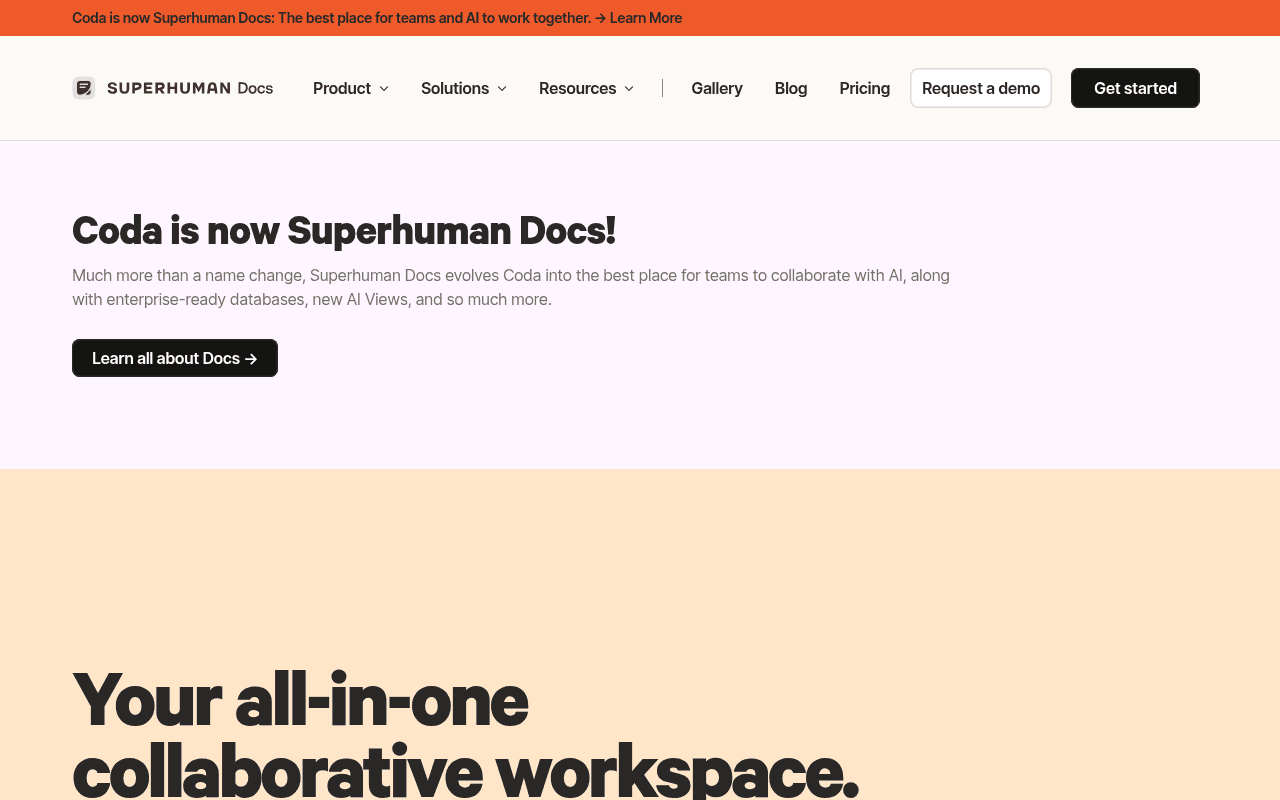
Five CTAs visible in hero/early sections: 'Get started with Superhuman Docs AI,' 'Request a demo,' 'Request a demo' (repeated), 'Get started,' 'Get started' (repeated). Additionally, the page fragments attention across four competing use cases ('Writeups,' 'Hubs,' 'Trackers,' 'Applications') before any CTA, forcing visitors to choose which path applies to them. The rebranding announcement ('Coda is now Superhuman Docs!') creates a meta-decision: Is this a new product or the same tool renamed?
Consolidate to one primary CTA ('Get started free') in the hero. Move 'Request a demo' below the fold. Remove the rebranding announcement from the hero or clarify it as a feature update, not a product pivot. Guide visitors to one use case first (e.g., 'Start with Writeups') before showing alternatives.
Legal trust links
Privacy Policy found, but no Terms of Service link
Add Terms of Service link (baseline trust signal).
Hero 5-second test
H1: 'Your all-in-one collaborative workspace.' Subhead: 'Coda brings teams and tools together for a more organized work day.' WHAT is clear (collaborative workspace tool), but WHO is vague—'teams' is generic and doesn't specify industry, company size, or use case. The rebranding announcement ('Coda is now Superhuman Docs!') adds confusion about whether this is a new product or a rename.
Specify the primary audience in the subhead. Example: 'Coda brings product, engineering, and operations teams together...' or 'For teams tired of juggling Docs, Sheets, and Notion...' This removes ambiguity about who benefits most.
Headline specificity
'Your all-in-one collaborative workspace' is generic buzzword language ('all-in-one' appears in thousands of SaaS headlines). No specific outcome, number, or differentiation is stated. The subhead adds 'more organized work day' but lacks concrete proof or mechanism.
Replace with a specific outcome or comparison. Example: 'Replace 5+ tools with one workspace' or 'Cut meeting prep time by 60% with AI-powered docs.' Include a number or concrete before/after state.
Independent automated analysis by PageLint. Not affiliated with or endorsed by Coda. Findings reflect the public landing page as fetched on October 15, 2026 and may not match the current version.
How this was scored: 16 Clarity and Trust checks, each tied to a cited source (see all checks). No brand paid to be here. Coda can request a re-audit at [email protected]. The Full Report ($12 one-time) runs all 55 checks. The free landing page checker runs the same 16 checks on any public URL.
See how your page scores on the same 16 checks
Paste your URL and get a score out of 100, with each finding quoted from your page and the source behind the rule. About 60 seconds, free, no signup.
Compare Coda
- Coda vs ClickUp: landing page copy compared · 74 vs 77 for ClickUp
More project management teardowns
- Trello landing page teardown · 90/100
- Basecamp landing page teardown · 85/100
- Monday landing page teardown · 80/100
Related research
- Social proof without 'as seen in' logos · 7 min read
- CTA copy that works: action verb + outcome, not 'Submit' · 6 min read
- The Trust lens: 8 checks for landing pages visitors believe · 12 min read