Jira landing page teardown: what to change
Jira scores 79/100 on PageLint's quick copy audit — a solid result with clear room to tighten. Trust is the stronger lens at 89/100, while Clarity trails at 69/100. The biggest issue the engine flagged: “Jargon and insider terminology” (CL-5, high severity).
What to change
- 1 · CL-5 · highJargon and insider terminology
Hero and body text cluster multiple unexplained technical terms without plain-language glosses: 'agent-ready tasks,' 'Teamwork Graph,' 'MCP,' 'CLI,' 'Rovo AI,' and 'system of record into a system of action.' The page does not explicitly state a secondary non-technical audience, yet product-level jargon ('CLI,' 'MCP,' 'Teamwork Graph') appears in the hero fold without definition. A non-technical founder or journalist would need to Google 3+ terms to decode the primary value prop.
Rewrite hero and first section in plain language accessible to both technical and non-technical buyers. Introduce Atlassian-specific terms (Teamwork Graph, Rovo, MCP, CLI) only after a plain-language benefit statement. Add parenthetical definitions or a glossary for acronyms in the hero section.
CXL Institute conversion research: Jargon barriers reduce comprehension by 31% for secondary audiences. Ogilvy: 'The words that work best are the words your customers use.'
- 2 · TR-4 · mediumAuthority signals verifiable
Press/authority claim detected (Trusted by) but the logos/text are not linked to verifiable sources.
Wrap each press logo or 'Featured in' badge in an <a href> pointing to the actual article or brand page. Unlinked authority claims invite scepticism — the reader cannot verify them.
Cialdini, Influence, Ch. 5 (Authority); Ogilvy
- 3 · CL-3 · mediumHero 5-second test
H1: 'Turn plans into agent-ready tasks' + subhead body: 'Then build. Orchestrate work across your team and agents, with complete context.' WHAT is partially clear (task management for teams + AI agents), but WHO is ambiguous — the page doesn't establish if this is for engineering teams, non-technical teams, or both. 'Agent-ready' assumes familiarity with AI agent terminology without defining the audience.
Add a clear WHO statement in the hero section that identifies the primary audience and their role/context before or after the H1. Consider a subheading that names the audience explicitly.
Ogilvy, 'Confessions of an Advertising Man' (1963): 'The consumer isn't a moron; she is your wife. But she does not read your headlines.'
Before → after
PageLint drafted these rewrites from the audited page text and the findings above. Treat them as proposals for Jira to test. Any claim in them must match the company’s real terms.
"Agent-ready" is jargon, and the H1 does not say who Jira is for or what it tracks (CL-3, CL-5).
"Orchestrate" and "complete context" are abstract. The rewrite names concrete objects a visitor already knows (CL-4, CL-5).
The page pushes Jira, Teamwork Graph, Rovo and AI Search at once. A visitor has to pick a product before picking an action (CL-6).
Expected impact
These rewrites target CL-3, CL-5, CL-4, CL-6. If they ship, those checks should stop failing on a re-audit, which would lift the 79/100 score. We have not re-scored them yet and we do not claim a conversion lift, because we have no conversion data for Jira.
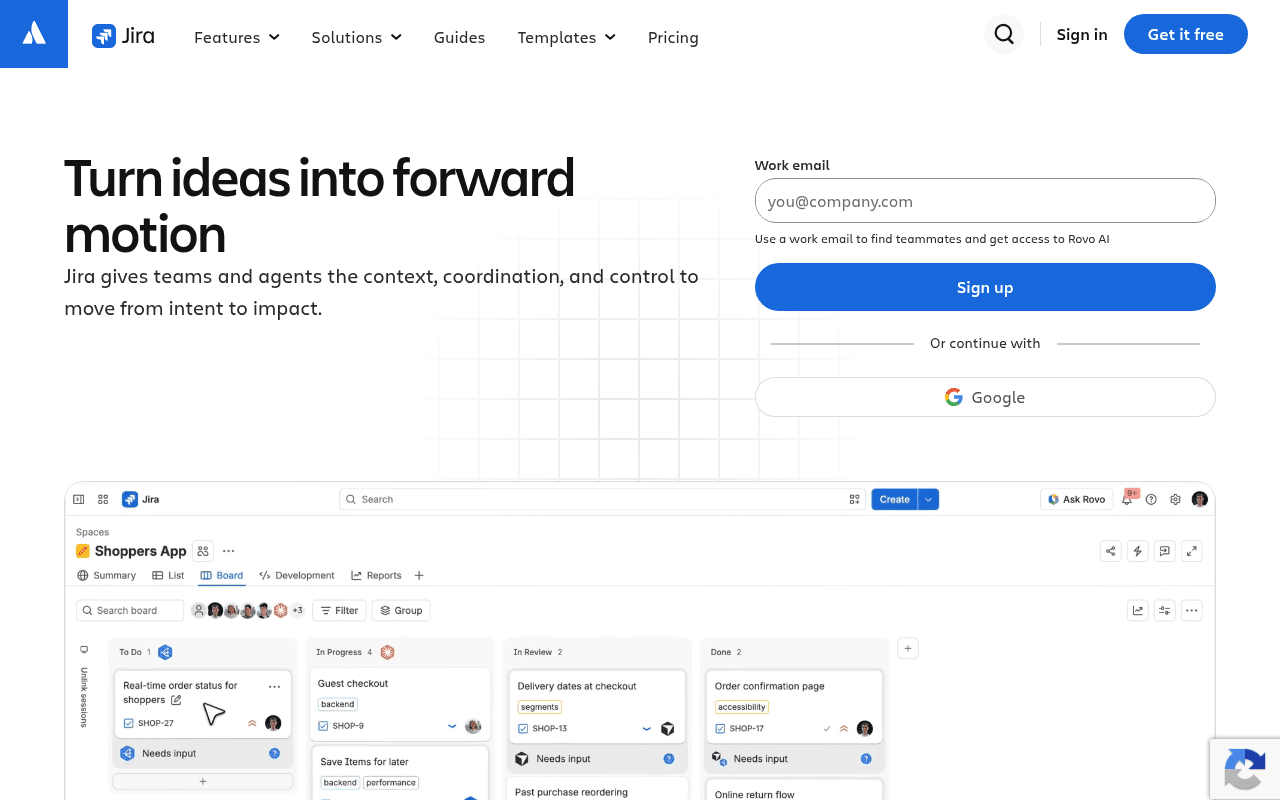
All findings
6 findings shown · 10 of 16 checks passing
Jargon and insider terminology
Hero and body text cluster multiple unexplained technical terms without plain-language glosses: 'agent-ready tasks,' 'Teamwork Graph,' 'MCP,' 'CLI,' 'Rovo AI,' and 'system of record into a system of action.' The page does not explicitly state a secondary non-technical audience, yet product-level jargon ('CLI,' 'MCP,' 'Teamwork Graph') appears in the hero fold without definition. A non-technical founder or journalist would need to Google 3+ terms to decode the primary value prop.
Rewrite hero and first section in plain language accessible to both technical and non-technical buyers. Introduce Atlassian-specific terms (Teamwork Graph, Rovo, MCP, CLI) only after a plain-language benefit statement. Add parenthetical definitions or a glossary for acronyms in the hero section.
Authority signals verifiable
Press/authority claim detected (Trusted by) but the logos/text are not linked to verifiable sources.
Wrap each press logo or 'Featured in' badge in an <a href> pointing to the actual article or brand page. Unlinked authority claims invite scepticism — the reader cannot verify them.
Hero 5-second test
H1: 'Turn plans into agent-ready tasks' + subhead body: 'Then build. Orchestrate work across your team and agents, with complete context.' WHAT is partially clear (task management for teams + AI agents), but WHO is ambiguous — the page doesn't establish if this is for engineering teams, non-technical teams, or both. 'Agent-ready' assumes familiarity with AI agent terminology without defining the audience.
Add a clear WHO statement in the hero section that identifies the primary audience and their role/context before or after the H1. Consider a subheading that names the audience explicitly.
Single message focus
Five CTAs visible: 'Get it free' (appears 3x), 'Sign up,' and 'Get started for free.' Beyond the button repetition, the page promotes three distinct products/features with their own CTAs: 'Explore Teamwork Graph' (2x), 'Meet Rovo,' plus the primary 'Get started for free.' A visitor faces a meta-decision: Is the primary offer Jira itself, the Teamwork Graph feature, Rovo AI, or the AI Search tool?
Consolidate to one dominant CTA in the hero ('Get started for free'). Defer feature-specific CTAs ('Explore Teamwork Graph,' 'Meet Rovo') to lower sections after the visitor has committed to the primary offer. Remove CTA button repetition.
Headline specificity
'Turn plans into agent-ready tasks' uses an action verb (Turn) and a concrete output (agent-ready tasks), but 'agent-ready' is jargon-dependent and doesn't specify a concrete outcome (time saved, speed improvement, etc.).
Pair the action with a quantifiable or tangible outcome if possible. If specificity cannot be added without losing concision, ensure the supporting subhead or first body paragraph delivers the outcome.
Real human faces present
Named individuals with roles appear throughout testimonials: Matthew Hargreaves (Head of Product Delivery and Automation), Matt Chester (Senior System Engineer), Joe Cotant (Senior Technical Program Manager), Rob Mulvaney (Sr. Manager - Agile Transformation Office), Sarah Brown (Vice President of Marketing), Ryan Mosley (Chief of Factory & Engineering Modernization). Image alt texts reference 'Matthew Hargreaves headshot' and 'Matt Chester headshot', indicating real photos exist. However, visual analysis is unavailable to confirm authenticity or verify that all named individuals have corresponding real photos.
Ensure all named testimonial speakers have accompanying real headshots (not stock photography) and verify headshot alt text accurately describes the individual.
Independent automated analysis by PageLint. Not affiliated with or endorsed by Jira. Findings reflect the public landing page as fetched on October 15, 2026 and may not match the current version.
How this was scored: 16 Clarity and Trust checks, each tied to a cited source (see all checks). No brand paid to be here. Jira can request a re-audit at [email protected]. The Full Report ($12 one-time) runs all 55 checks. The free landing page checker runs the same 16 checks on any public URL.
See how your page scores on the same 16 checks
Paste your URL and get a score out of 100, with each finding quoted from your page and the source behind the rule. About 60 seconds, free, no signup.
Compare Jira
- Jira vs Asana: landing page copy compared · 79 vs 66 for Asana
- Jira vs Basecamp: landing page copy compared · 79 vs 85 for Basecamp
More project management teardowns
- Trello landing page teardown · 90/100
- Basecamp landing page teardown · 85/100
- Monday landing page teardown · 80/100